
Why Enterprise SaaS Is Shifting to Outcome-Based Pricing
Zendesk charges your enterprise $115 per agent seat per month whether that agent resolves five tickets a day or fifty. Intercom Fin charges $1,500 a month flat. Sierra charges $6,000 a month flat with a contracted resolution volume baked in. Decagon charges $5,000. Ada charges $4,500. Notice what's missing from that list: seats. The AI-native cohort isn't pricing on headcount because their own cost-to-serve isn't headcount-bound — and that one accounting reality is quietly dismantling the contract that finance teams have argued over for two decades.
The seat model was always a proxy
The per-seat model survived this long because it was a clean proxy for value during the cloud era. More users equaled more usage equaled more revenue on the vendor side, and on the buyer side, "users" was a number procurement could audit. A 12,000-seat Salesforce deal at $100 per seat per month is $14.4M a year. Everyone could agree on what was being counted, even if nobody could agree on whether the counts were honest.
The problem is that AI products don't have users in the same sense. An AI customer-support agent doesn't sit at a desk. It doesn't take vacation. It doesn't fail to log in for a quarter while a manager forgets to remove its license at renewal — which is the entire economic engine that makes seat compression work on traditional SaaS. The vendor's cost-to-serve is now compute, model tokens, and inference latency. None of those scale with seat count. They scale with resolutions, calls, queries, and contracted volume bands.
So vendors did the only thing that made sense: they started pricing on the thing they were actually selling.
What the AI-native catalog actually looks like
Walk down the customer-support AI roster and the pattern is immediate. Intercom Fin is $1,500/mo. Decagon is $5,000/mo. Sierra is $6,000/mo. Ada is $4,500/mo. None of those numbers are per-seat. None of them scale with how many human agents you have. Each one carries an implicit or explicit contracted volume — Sierra publishes resolution-band tiers, Decagon negotiates them in the MSA, Intercom Fin meters on a $0.99-per-resolution overage past the included pool.
The flat-fee structure also carries a setup cost that traditional SaaS never had to surface. Sierra runs roughly $35,000 to stand up. Decagon roughly $25,000. Glean roughly $50,000 on the knowledge side. These aren't hidden — they're disclosed line items because the vendor knows the first-year ROI math hinges on them. Compare that to the seat side: Zendesk at $115/seat/mo, Intercom at $85/seat/mo, Freshdesk at $49/seat/mo. There is no setup line. The seat is the entire price, fully loaded.
That asymmetry is the thing finance teams are being asked to absorb.
Why CFOs should be cheering, quietly
Outcome-based contracts have a single structural property that destroys the bug procurement has been fighting since the dawn of SaaS: they can't auto-renew at inflated seat counts because there are no seats.
The single biggest source of waste on a SaaS line item isn't sticker price. It's the gap between contracted seats and active seats — the licenses you bought three years ago when the team was bigger, when the project was hotter, when the procurement cycle was easier than the renegotiation cycle. Audit any enterprise stack and you'll find tools running at 65% utilization, sometimes lower. That's the hidden cost auto-renewal clauses finance teams pay every year without noticing, because the invoice doesn't itemize the dead seats.
Outcome-based contracts don't have that failure mode. If your Sierra contract is sized for 50,000 resolutions a year and you only consume 32,000, your CFO sees that the moment the usage dashboard renders. There's no equivalent of the dormant Zendesk seat sitting on payroll forever. The waste is visible, immediate, and reconcilable against an actual unit of business activity.
The trade-off, and it's a real one, is that finance now has to learn a new contracting motion. Seat audits become volume audits. Notice periods become true-up windows. The renewal lever isn't "drop us from 450 seats to 320" — it's "we're trending 22% below the volume band; we want to step down a tier without paying the overage clause." That's a different conversation, with different leverage. We wrote about the specific mechanics of that conversation in per-resolution agents and the crossover point.
The volume cliff is the new auto-renew
Every outcome-based contract has a volume band. Sierra sells in resolution tiers. Decagon sells in conversation tiers. Intercom Fin sells you a pool of resolutions plus a per-resolution overage. The cliff lives in the minimum commitment — the floor below which your effective per-unit cost balloons because you're paying for a tier you're not using.
Worked example. A 12,000-employee SaaS company runs Zendesk on 280 seats at $115/seat/mo. That's $32,200/mo, $386,400 a year, and a chronic 30% utilization gap because half the agents are tier-2 escalation specialists who handle a fraction of the volume the dashboard suggests. Industry compression data on AI support agents anchors at 50–65% on the resolvable-ticket slice — Decagon's seeded compression against Zendesk is 0.65, Sierra's is 0.60, Intercom Fin's is 0.50, Ada's is 0.60. Take the conservative end. The CFO can plausibly deflect 50% of the live ticket volume into an AI agent.
What does the contract look like?
- Option A (Sierra-shaped): $6,000/mo flat, plus the $35,000 setup, on a contracted band of (say) 80,000 resolutions a year. Annual run-rate $107,000.
- Option B (Intercom Fin-shaped): $1,500/mo flat with a small included pool, then $0.99 per resolution. At 80,000 resolutions billed at the per-unit rate that's $79,200 of usage on top of the $18,000 base — call it $97,200 annual.
- Status quo on Zendesk: $386,400 with the 30% utilization gap eating $116,000 of pure dead spend.
The Sierra and Fin options both clear the math comfortably against status quo. But notice what changed in the negotiation. The CFO isn't asking the vendor to drop seats. The CFO is asking the vendor to right-size the resolution band — and the leverage is a usage report, not a Workday export. The audit motion is different. The trigger is different. The renegotiation cycle is different. We laid out the full playbook structure for this in the per-resolution crossover analysis.
The bear case lives at the band boundary. If your volume swings 18% month-to-month and the vendor's bands step in 25% increments, you're either paying for headroom you don't use or paying overage on every spike. That's the new dead-seat problem in a different costume.
Datadog already showed us this movie
The CFO reflex on this — "outcome pricing is volatile, seats are predictable" — is correct in the short term and wrong in the long term, because the precedent already exists. Datadog has priced this way for a decade. Most of the engineering observability stack does. Splunk runs on ingested-GB. New Relic runs on platform-user-plus-data. Grafana Cloud runs on metrics-and-logs. None of those are seat businesses.
The aggregate result hasn't been chaos. It's been a tighter, more visible cost curve where the engineering org watches consumption in real time, and the budget conversation is "are we OK trading $40K/yr of Datadog cardinality for slower incident detection?" instead of "do we still need 80 Datadog seats?" The second question is unanswerable. The first one is a tractable trade-off.
The mental model the outcome-based AI vendors are pushing is the same one Datadog imposed on the SRE function fifteen years ago. Finance teams that operate stacks heavy in usage-priced tools already have these levers: tier-down on commit, negotiate on burst behavior, true-up at renewal instead of auto-renew at peak. The vocabulary is sitting there waiting to be lifted into the customer-support and revenue-ops categories.
What changes in the seat-side stack while this happens
The other thing finance should watch is what the per-seat vendors do in response. Zendesk Advanced AI is a $50/seat/mo add-on layered on top of the $115 seat. That's an attempt to defend the seat as the unit of account by absorbing the AI workload into the per-seat denominator. Salesforce Agentforce sits on top of Salesforce at $125/seat/mo for the AI piece. Microsoft 365 Copilot is $18/seat/mo bolted onto Microsoft 365.
These products exist because the incumbents understand exactly what the AI-native cohort is doing to them and would prefer to fight the war inside the seat envelope rather than concede the unit of pricing entirely. From a CFO's perspective, the question is whether the bundled-onto-seat AI add-on actually compresses your seat count over the contract horizon, or whether it merely raises the effective per-seat blended rate while preserving the same utilization gap.
The honest answer for most categories is that the bundled add-ons add cost without removing seats — they're augmentation rather than replacement. The unbundled AI-native products are the ones with structural pressure on the seat denominator, because they don't need the seat to exist.
What the CFO does Monday morning
Three concrete moves.
One: in every renewal touching customer support, IT ops, or sales-development tooling, demand a quote on the outcome-priced alternative. Sierra against Zendesk. Decagon against Zendesk. Intercom Fin against Intercom itself if you're already on the platform. Moveworks against ServiceNow's seat-based service ticketing. The quote-gathering is free; the comparison forces the seat vendor to defend the seat model or discount against it. Either outcome is good.
Two: rewrite the renewal-clause template before the next contract cycle. Volume-based contracts need a different shape. Add an explicit step-down right (the analogue of seat reduction), a usage-reporting cadence (so true-ups can't be argued away), and a cap on the per-unit overage rate (the volume-cliff defense). If the vendor refuses, that's a data point worth weighing against the seat option.
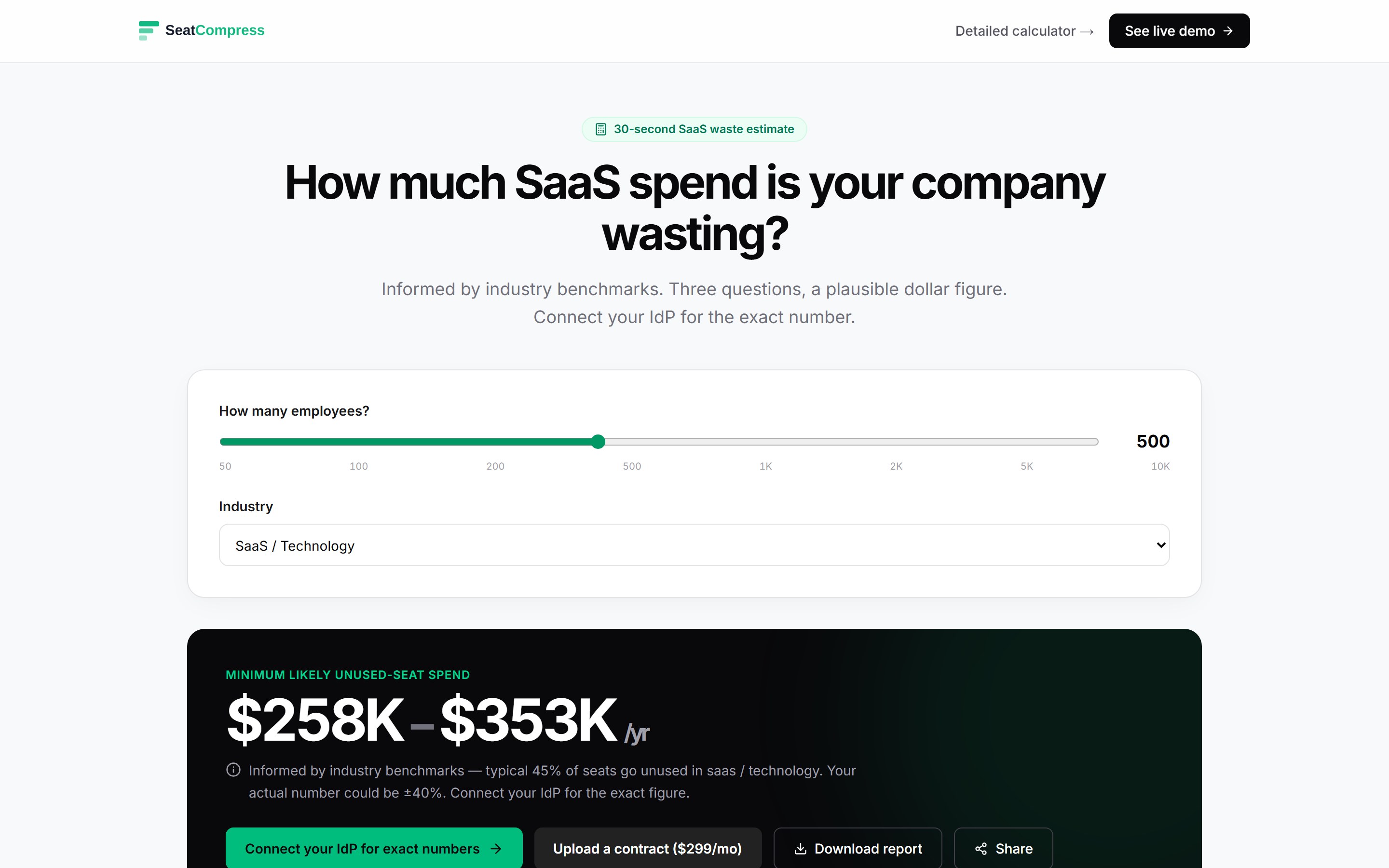
Three: model the breakeven on the seat-vs-outcome decision before sales hands you a deck. The math is straightforward — current annual cost × (1 − utilization gap) versus outcome contract base + (volume × per-unit rate) + setup amortized over the contract term. You can run the comparison on your stack right now via the SeatCompress calculator, which folds the realistic year-one realization factor into the deploy-vs-renegotiate decision so the breakeven isn't theoretical.
The seat model isn't dead. It still works fine for productivity tools, design software, and anything where the human-in-front-of-the-keyboard is genuinely the unit of value. But for the categories where AI now does the work — support, prospecting, IT triage, knowledge search — the unit of pricing is moving to the unit of work. CFOs who learn the new contracting motion in 2026 negotiate from leverage. CFOs who learn it in 2028 negotiate from whatever the vendor wants to give them.
Bet on the former.
Find your savings number in 30 seconds.
No signup, no credit card. Get the number, screenshot it, and decide if your CFO needs to know about us.