
The PEPM Blind Spot: Why HRIS Renegotiation Is About the Rate, Not the Seats
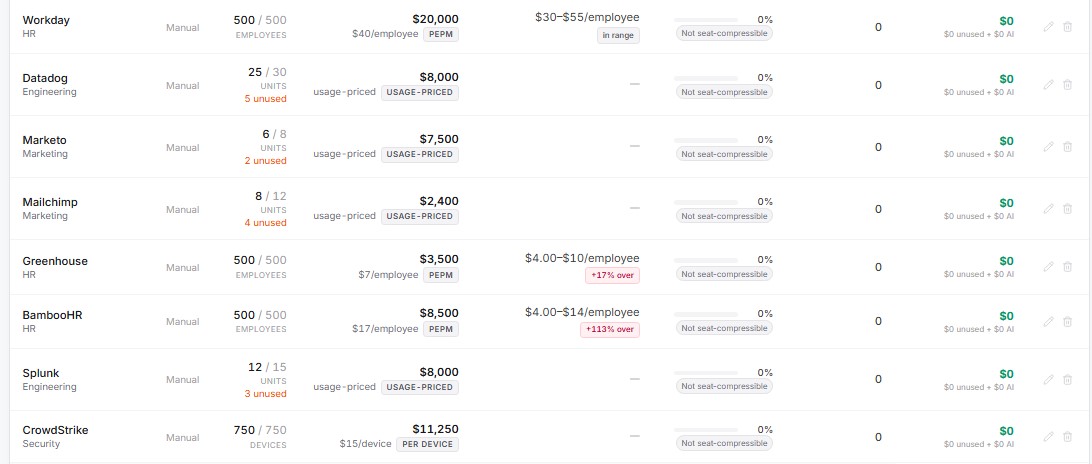
A 500-person company on BambooHR at the catalog reference rate of $17 PEPM is paying $102,000/year. The published peer-band rate for BambooHR at 500+ employees — sourced from Vendr's BambooHR marketplace — is $6 PEPM. Same product, same vendor — an $11-per-employee-per-month gap that compounds to $66,000/year above peer. Zero seat changes required. The lever is the rate.
That number doesn't show up on any unused-seats dashboard, because there are no unused seats to find. Every employee is in the HRIS by definition — that's the entire point of an HRIS. The seat-compression formula that works on Salesforce, Outreach, and Zendesk doesn't apply here. The renegotiation is dimensional: you're not asking "are we paying for seats we don't use?", you're asking "are we paying market for the seats we're locked into?"
Try the free calculator — 15 seconds, no signup.
Why per-employee pricing breaks the seat-compression model
Most SaaS pricing follows one of two patterns. The first is per-seat: Salesforce, Outreach, Slack, Notion. You buy 100 seats, you pay for 100 seats whether 100 people log in or not. The waste lives in the gap between provisioned and active. Renegotiation = drop the seat count to active.
The second is per-resolution or per-event: Intercom Fin charges $0.99 per resolved ticket. The waste lives in unbounded volume growth. We covered that math in the Fin vs. Zendesk breakdown — different pricing model, same dimensional principle: figure out what unit drives the bill and target that unit.
PEPM is a third pattern, and it's the one most CFO playbooks miss. Workday, BambooHR, Gusto, Rippling, Greenhouse, and Lever all price per employee per month. The unit of waste isn't seats and isn't events — it's the rate-times-headcount product, and there are only two levers:
- Reduce headcount (not a SaaS decision, and rarely the right move)
- Reduce the rate
Lever 2 is what this post is about. It's the only one most procurement teams can actually pull, and the one the legacy SaaS-spend platforms underweight because their core competency is seat-utilization analytics. We compared Zylo, Vendr, and Productiv on this exact gap — their dashboards flag "60% of your Salesforce seats are dormant" because that's the field every SSO log exposes. They don't flag "your BambooHR PEPM is 183% over the published band rate for your size" because that requires a vendor-priced benchmark dataset they don't maintain.
The mechanic: every employee is provisioned by definition
The unused-seats metric breaks here too, and it breaks harder than it does on per-seat tools.
On Salesforce, you can argue with HR about who actually needs a seat. Marketing manager hasn't logged in for 90 days? Drop them. The argument lives at the seat layer.
On Workday or BambooHR, there is no argument. If you have 500 employees, the HRIS bills for 500 seats. Every full-time employee gets payroll processed through the platform. Every employee gets a profile in the directory. The HRIS cannot run with fewer seats than your headcount — that's the system of record's whole job. Asking "can we provision fewer BambooHR seats than employees?" is asking "can we run payroll for fewer employees than we have?" The answer is structurally no.
This is why per-employee priced tools show up as renewal blind spots. The CFO opens the renewal calendar, sees BambooHR auto-renewing at $102K, asks the IT lead "can we cut seats?", gets back "no, we have 500 employees and they all need to be in the HRIS." End of conversation. The contract auto-renews. The $66K/yr gap above the peer band sits in the P&L for another year.
What the peer bands actually say
This is where the work gets concrete. We ship peer-pricing bands for the PEPM tools we've researched — sourced from Vendr's marketplace data, HarmonyHR's HRIS pricing guide, PriceLevel buyer reports, leonstaff buyer guides, and the vendors' own published rate cards. Each band is a single per-employee point estimate at a given headcount range, URL-pinned to a defensible source. Here's the enterprise-tier (500+ or 250+) band for the five PEPM tools where we have published data:
| Tool | Catalog rate | Published band rate | Gap at 1,000 emps |
|---|---|---|---|
| BambooHR | $17 PEPM | $6 PEPM (500+ employees) | $132K/yr above band |
| Gusto | $40 PEPM | $23 PEPM (250+ employees) | $204K/yr above band |
| Greenhouse | $7 PEPM | $5 PEPM (1,000+ employees) | $24K/yr above band |
| Lever | $6 PEPM | $5 PEPM (2,000+ employees) | $12K/yr above band |
| Rippling | $25 PEPM | $25 PEPM (250+ employees) | At band |
Three things to notice.
BambooHR and Gusto gaps are enormous in proportion. A 1,000-employee company paying $17 PEPM for BambooHR is paying $204K/year for a service whose published 500+ band rate is $6 PEPM ($72K/year). 2.8× spread on the same product. These aren't unicorn discounts; they're what a procurement team that asks for the standard volume discount at the published enterprise band gets.
Workday is the deliberate omission. Workday's published peer-band data is null in our catalog — explicitly sales-led, no defensible vendor-published ladder, anti-fabrication contract honored. If you're a Workday customer at scale, the audit looks different: you can't compare against a published band because there isn't one. You're benchmarking against your own RFP, against other Workday customers willing to share contract terms under NDA, and against what your account team admits they offered the last competitive bid. That's a different motion than the BambooHR walk-in. We won't fabricate a Workday number to make this post tidier.
Rippling, Lever, Greenhouse are at or near band. Rippling at 250+ employees has a published band rate of $25 PEPM vs. our $25 catalog reference — most Rippling customers at enterprise scale are at or close to band, because Rippling sells a stack-bundle (HR + IT + Devices + Apps) that justifies higher PEPM. Renegotiating Rippling down from $25 isn't usually winnable. BambooHR from $17 is — the data says so. Knowing which is which is the difference between a productive renewal conversation and a credibility-burning one.
Worked example: 500-employee BambooHR contract
500-person company. Renewal in 60 days. Current BambooHR contract: $17 PEPM × 500 × 12 = $102,000/year. Catalog reference rate — likely Pro tier, mid-market negotiated, no further discount applied. Login rate 100% (every employee logs in to view paystubs). Engagement 100% (payroll runs for everyone monthly). The legacy unused-seats dashboard reports zero waste.
The published band for BambooHR at 500+ employees: $6 PEPM. Source: Vendr's BambooHR marketplace, cross-referenced against HarmonyHR's HRIS Pricing 2025 ($4–$10 Core, $7–$18 with payroll at the 500+ band).
Two renegotiation scenarios:
- At band ($6 PEPM): contract drops $102K → $36K. $66K/yr saved. The headline number. The published 500+ band is what a procurement team that asks for the standard enterprise discount, cites the source, and shows willingness to walk typically lands on.
- Below band (sub-$6, multi-year + bundled modules): contract drops further, but the savings curve flattens. For context, Lever — a comparable PEPM-priced vendor — lands at $4 in HarmonyHR's 501+ band, illustrative of what aggressive multi-year terms can achieve on PEPM tools generally; some BambooHR customers have landed near that with aggressive 3-year terms.
Honest CFO model: walk in asking for the band rate, expect to land there with a small premium for whatever specific modules you've added (advanced reporting, performance management, payroll), and treat anything below band as a stretch goal that requires a competitive bid in hand. Even the standard-band settle is $66K/year recovered on a tool where the unused-seats dashboard says nothing is wrong.
Why this scales at enterprise
At 5K-50K employee scale, the dynamic compounds two ways.
The per-tool denominator gets bigger. A 5,000-employee company on BambooHR at $17 PEPM is paying $1.02M/year. The gap to the published 500+ band of $6 is $660K/year. At 10,000 employees the same gap is $1.32M/year. The renegotiation conversation isn't "save $66K" — it's "save seven figures by aligning your contract to your vendor's own published enterprise band rate."
The categories stack. A 10,000-employee SaaS or services company typically runs three to five PEPM-priced tools at once: an HRIS (Workday or BambooHR), an ATS (Greenhouse or Lever), sometimes Gusto for a payroll spinoff, Rippling for a bundle, plus performance management. Each PEPM-priced tool with a published band has its own gap to audit. Even at modest deltas — $1 PEPM per tool above band, across four tools — that's $480K/year on a 10K-employee deployment without any seat changes.
The reason no one is doing this systematically: published per-employee bands don't exist in most procurement tools. Vendr ships them but only to Vendr customers. PriceLevel sells access by report. HarmonyHR publishes a deep guide but doesn't surface it through any spend-management UI. The work of normalizing "what does a 1,000-employee BambooHR customer actually pay" into a single defensible per-employee rate — and pinning the number to a vendor URL or buyer-report claim — is what most CFO teams don't have time for between earnings cycles.
The renegotiation playbook
Five steps you can run before the next HRIS renewal.
Step 1: Identify every PEPM-priced tool in your stack. Catalog reference rates we publish: BambooHR $17, Gusto $40, Rippling $25, Greenhouse $7, Lever $6. Workday is in the catalog but priced sales-led — no published band, audit it via your own RFP history instead. Lattice and Deel are PEPM-priced but we haven't published a peer band yet — don't cite a peer comparison for them either; benchmark against your own past quotes.
Step 2: Pull your actual PEPM, not your ACV. Open the contract. Find the per-employee per-month rate. Some vendors write it explicitly. Others write a flat fee that decomposes — Gusto's Simple plan is "$49 base + $6 PEPM," which at 50 employees is ($49 + $6 × 50) ÷ 50 = $6.98 effective. Do the math. Your PEPM is the only number that matters for benchmarking.
Step 3: Match your headcount to the vendor's published headcount band. Each vendor's published bands have different breakpoints — BambooHR slices at 1-25 / 26-99 / 100-499 / 500+; Greenhouse at Under 50 / 50-249 / 250-999 / 1,000+; Gusto at 1-9 / 10-49 / 50-249 / 250+. A 5,000-employee company is in the top band of every PEPM vendor that publishes one. The vendor's salesperson will sometimes quote a mid-band rate; always demand the top-band rate that applies to your size.
Step 4: Walk in with the published band, not a stretch goal. First-call asks should target the published enterprise band rate. The vendor will tell you "no one gets that rate." Cite the source — Vendr's marketplace listing, HarmonyHR's published HRIS guide, the vendor's own public ladder. Don't bluff; the vendor's account team will know which datasets are real. Once you're at the band, the second-round conversation is multi-year + bundled modules to push below it.
Step 5: Get the next renewal in the contract. Whatever rate you negotiate, lock the renewal clause: "rate not to exceed CPI for the term." Single most important contractual addition, the one most procurement teams forget. Without it, the vendor resets you to list at year three and the $66K/year you saved evaporates in one cycle.
That's the playbook. Not glamorous. Mostly contract reading and source citing. The dollar magnitude on a single 5,000-employee enterprise stack regularly clears six figures of recovered spend across the PEPM-priced HR category alone — none of it on a seat-utilization dashboard.
Try the free calculator — 15 seconds, no signup. Plug in your PEPM-priced tools and we'll surface the gap to published band against your actual headcount.
The bottom line
The unused-seats metric breaks on per-employee priced tools because every employee is in the HRIS by definition. There is no Layer 1 waste to find — the contract is structurally right-sized to your headcount. The waste lives at Layer 0: the rate itself, compared against the vendor's published band for your size.
For most enterprises, the largest single recoverable line item in the HR stack isn't a Workday module you can drop — it's the gap between your PEPM and the published peer band for the vendors where one exists. Sometimes that gap is small. On Rippling and Lever at scale it's often near zero. On BambooHR and Gusto at enterprise scale it's regularly 2-3× the published band rate.
The CFOs who run this audit before the next renewal find numbers their procurement team didn't surface — because procurement was looking at seats, and the lever was the rate. One BambooHR renegotiation typically pays for the entire SeatCompress engagement. The Workday audit, where it lands, depends on what your last competitive bid looked like — because there is no published band to anchor against, and we'd rather tell you that honestly than invent a number.
Find your savings number in 30 seconds.
No signup, no credit card. Get the number, screenshot it, and decide if your CFO needs to know about us.