
Budget-Cut Quarter: Which SaaS Seats to Cut First
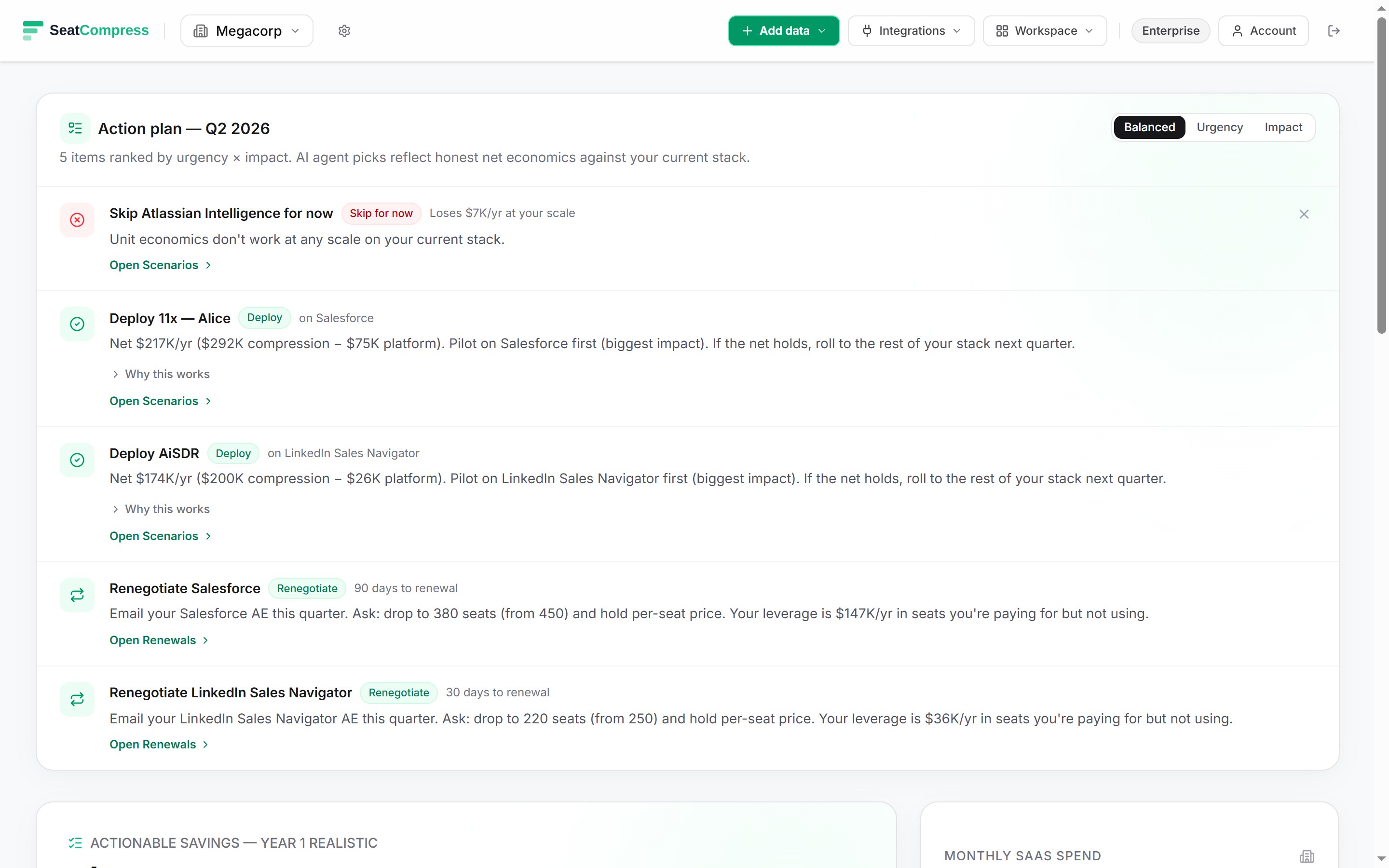
The board asked for 15% out of the SaaS line by end of quarter. You have ninety days. The instinct is to start with the biggest line items — Salesforce, ServiceNow, the seven-figure ELAs — and that instinct is wrong. In a budget-cut quarter, cuts should be ranked by realization speed, not by gross savings: dormant per-seat licenses inside the 90-day notice window come off the books in 30 days, mid-renewal renegotiations land in 90 to 180 days, and AI agent pilots without a clear unlock threshold within 12 months get paused — in that order.
Why realization speed beats gross savings this quarter
Every CFO has seen the slide deck where a procurement consultant promises $3M of savings on the Salesforce ELA. The slide is correct. The timing is not. That renegotiation lands at the next renewal, which is eight months out, which means it doesn't help the quarter you're in.
The math we run on every customer's stack reflects this gap. Renegotiation actions get a 0.5 realization factor in year one — half of the theoretical savings, because vendors push back, multi-year locks bite, and minimums hold the floor. AI agent deployments get 0.4 — first-year ramp curves consistently put steady-state realization at 30 to 50% in year one. Both factors are documented in our action-plan engine and applied automatically when we compute the year-one hero number on the dashboard.
But neither factor is the right lens in a budget-cut quarter. The right lens is time-to-cash. A 0.5 realization factor on a $3M renegotiation that closes in eight months is worth zero this quarter. A 1.0 realization factor on $180K of dormant seats inside the 90-day notice window is worth $180K this quarter. Order operations accordingly.
Tier 1: dormant per-seat licenses inside the notice window (30-day realization)
This is the cleanest cut and almost always the most under-pursued. Three conditions have to hold:
- The tool is
per_seatpriced. PEPM tools (Workday at $40 per employee, Rippling at $25, Zylo at $120, Productiv at $150) don't compress on seat utilization — the bill divides into headcount, not into login counts. CrowdStrike at $15 per endpoint behaves the same way. Cutting "unused" seats on PEPM tools is a category error: the line item doesn't move. - The contract has a notice clause shorter than your remaining runway. Most enterprise SaaS contracts carry 60 to 90-day notice requirements with auto-renew defaults. If the next renewal is 120 days out and notice is 60 days, you have a 60-day window to file written notice of a seat reduction. Miss it and the contract auto-renews at the existing seat count.
- The activity gap is real. Provisioned 200, logged in 130 over the trailing 30 days, you have 70 seats of pure waste. The math: 70 seats × $125 per seat per month × 12 = $105K of annual waste on one ZoomInfo deployment, before any AI agent enters the picture.
The vendors where this hurts the most at enterprise scale: ZoomInfo at $125 per seat per month, Outreach at $100, Gong at $100, Salesloft at $125, Salesforce at $100. Notion is the sleeper — $10 per seat per month sounds harmless, but at 5,000 provisioned seats with a 35% activity gap you're looking at $210K of annual waste on one tool that nobody's even auditing.
Action this quarter: pull the provisioned-vs-active delta from your IdP (Okta, Azure AD, Workspace), file the seat reduction notice in writing, and book the savings against current-quarter targets. No vendor conversation required, no renegotiation cycle, no LLM-pilot kickoff. The only failure mode is missing the notice window — which is why this lives at the top of the list. Auto-renewal clauses are where most of this savings leaks out, and the 30-second IdP audit is the fastest path to the number.
Tier 2: mid-renewal renegotiations on PEPM and overpriced per-seat (90-180 day realization)
Once the dormant-license sweep is filed, the next move is the renegotiation backlog. Two sub-cases sit here.
PEPM rate cuts. Workday at $40 per employee per month, Zylo at $120 per employee, Productiv at $150 per employee — these don't compress on activity, but they almost always compress on rate. Peer benchmarks typically run 15 to 25% below list at enterprise scale, and the larger the headcount the more leverage. The cycle is 90 to 180 days: data room, peer-benchmark anchor, escalation, signature. Half of theoretical lands in year one (the 0.5 realization factor). The PEPM rate-renegotiation playbook walks the dimensional moves.
Per-seat tier downgrades. Most enterprise SaaS catalogs carry a published tier ladder — Pro at $X, Business at $Y, Enterprise at $Z. The tier-mapping logic we run on every connected tool finds the closest priced tier within a 30%-of-cost confidence band. When you're paying Enterprise rates for what's actually a Business-tier feature set, the chip surfaces "drop to Business · save $XK/yr." Salesforce customers on Unlimited paying a premium over Enterprise list rates is the prototypical case: at a 25% list-rate delta on 1,200 seats at the Enterprise $100 anchor, that's roughly $360K of theoretical gross — $180K realistic — landing at the next renewal. The Salesforce renegotiation walkthrough is the canonical version of this conversation.
The reason these go in Tier 2 instead of Tier 1 is purely the timing: vendors will not give you a mid-cycle rate cut on a multi-year ELA without a churn threat, and even with one the cycle is 90 days minimum from data room to signed amendment. If the renewal isn't within the quarter, the cash doesn't land in the quarter. Sequence accordingly.
Tier 3: AI agent pilots without an unlock threshold within 12 months (immediate pause)
This is where most cuts get done wrong. The AI agent pilot looked good at the start of the year. The compression math penciled. Now the board wants 15% out and the pilot is six months in with no measurable seat reduction yet. The instinct: keep it running, it's strategic. The math: pause it, and re-evaluate at the next renewal.
The way to do this without litigating "strategic" is to look at the unlock threshold. Every flat-fee agent in our catalog carries a minimum deployment scale where year-one savings clear the agent cost plus setup. Below that scale, the agent is a net cost in year one. Three concrete examples:
Sierra ($6,000/mo flat + $35,000 setup = $107K year-one cost). To clear that cost with Sierra's 60% Zendesk compression rate at a Zendesk list cost of $115 per seat per month, each active Zendesk seat carries $828/yr of theoretical compression value (1 × 0.60 × $115 × 12). Break-even at theoretical gross: $107K / $828 ≈ 130 active Zendesk seats (~78 seats compressed) before Sierra clears year-one cost.
Decagon ($5,000/mo flat + $25,000 setup = $85K year-one cost). Same math — 65% compression on Zendesk at $115 per seat gives $897/yr theoretical compression value per active seat (1 × 0.65 × $115 × 12). Break-even at theoretical gross: $85K / $897 ≈ ~95 active support agent seats before year-one payback. Apply the 0.4 realization factor and the break-even moves to closer to ~237 active Zendesk seats before year-one net clears zero on the realistic factor the dashboard uses.
Glean ($6,000/mo flat at the 100-seat reference price + $50,000 setup = $122K year-one cost). Glean is the clearest case because the setup cost is the highest in the catalog. It compresses Confluence (40%), Notion (30%), Dropbox Business (15%), Box (15%). To clear $122K on Confluence alone at $5.16 per seat per month with 40% compression, you'd need ~4,900 active Confluence seats at theoretical gross — many multiples of that once the 0.4 realization factor is applied. Stack Notion, Dropbox, and Box on top and the threshold drops, but the point is the math has to be done, not assumed.
If your enterprise is past the realistic-factor threshold and the pilot is actually deployed against the targeted SaaS tools, keep it running. If you're below that threshold OR the deployment hasn't started removing seats from the targeted tool, the year-one ROI is negative. Pause it, book the avoided agent cost as savings, and revisit at the targeted tool's next renewal when you have leverage to do the swap properly. The Intercom Fin / Zendesk seat-replacement math and the AiSDR / Salesforce compression worked example both work this conversation end-to-end.
What does NOT get cut first
Three categories CFOs reach for that we'd push back on.
The headline ELAs. Salesforce, ServiceNow, Workday at the contract level — these are 8-to-12-month projects and the gross savings are tempting, but the cash doesn't land this quarter. Start the work, but don't book the savings against current-quarter targets. Sequence the data room and the peer-benchmark anchor now so the renewal cycle has the analytics ready.
The collaboration suite. Microsoft 365 or Google Workspace at $12.50 per seat per month, Slack at $15 per seat — these look like they should compress, and they sort of do (Slack's aiReplacementPotential is 0.30, M365's is 0.10), but the practical compression in a single quarter is near-zero. These tools are used by everyone, the activity gap is small, and "Microsoft Teams replaces Slack" is a 12-month migration, not a 90-day cut.
AI productivity subscriptions like ChatGPT Team, Claude Team, or Perplexity Enterprise. These aren't seat-compression targets in the AI-agent sense — they are themselves AI tools, and our catalog explicitly does not map agent compression onto other AI products. If you want to cut them, do it on usage gap, not on "an AI agent will replace it." Dormant ChatGPT Team seats at $25 per seat per month are a Tier 1 cut on the same logic as dormant Notion seats: pull the activity data, file the seat reduction, book the savings.
Worked example: a 12,000-employee SaaS company, $14M annual SaaS spend
The setup. Mid-cap SaaS, 12,000 employees, $14M of trailing-twelve SaaS spend. Board mandate: 15% out by end of quarter — $2.1M annualized, but in practice the CFO wants $1M of in-quarter savings booked and a credible plan for the rest.
Tier 1 sweep (45 days). IdP pulls reveal:
- ZoomInfo: 240 provisioned, 168 active. 72-seat reduction at $125/seat/mo = $108K annualized. Notice window: 60 days. Filed.
- Outreach: 300 provisioned, 235 active. 65-seat reduction at $100/seat/mo = $78K annualized. Filed.
- Gong: 280 provisioned, 220 active. 60-seat reduction at $100/seat/mo = $72K annualized. Filed.
- Salesforce: 1,400 provisioned, 1,180 active. 220-seat reduction at $100/seat/mo = $264K annualized. Filed; lands at the renewal 90 days out.
- Notion: 8,500 provisioned, 5,800 active across the org. 2,700-seat reduction at $10/seat/mo = $324K annualized. Sweep of this size on a tool used by every department is a 90-day-plus organizational exercise (department-by-department de-provisioning, exception handling, executive sign-off). Filed; lands at the renewal cycle, not in-quarter.
Tier 1 in-quarter realized (the three sub-90-day, single-department sweeps): $108K + $78K + $72K = $258K annualized. Tier 1 booked-but-not-yet-realized (filed against next-quarter renewals): $264K (Salesforce) + $324K (Notion) = $588K annualized. Tier 1 total $846K.
Tier 2 review (90-180 days). Renewal calendar shows Workday at $40/employee/mo coming up in 120 days. 12,000 employees × $40 × 12 = $5.76M annualized. Peer-benchmark anchor in the enterprise band is typically 15 to 25% below list at this scale — call it a 20% rate-cut target as a working assumption (the actual peer figure for your headcount band is what we surface on the dashboard chip). Theoretical savings at a 20% cut: $1.15M. Realistic year-one (0.5 factor): $576K. Won't book this quarter, but credible for next quarter's board update.
Also in Tier 2: Salesforce tier review. The 850 active reps currently provisioned on the top tier are paying a premium versus Enterprise list. At a 25% list-rate delta on those 850 seats at the $100 Enterprise anchor, that's roughly $255K of theoretical gross. Realistic year-one (0.5 factor): $128K, landing at the renewal.
Tier 3 review (immediate). Two AI pilots in flight, both under 6 months old:
- A Glean pilot at $6,000/mo + $50,000 setup, scoped to Confluence-only (Notion / Dropbox / Box are not in the pilot scope today). Confluence base is 4,200 seats at $5.16/seat/mo. At 40% theoretical compression that's ~$104K of theoretical gross; at the 0.4 realization factor, realistic year-one gross is ~$42K against Glean's $122K year-one cost. Net year-one: negative ~$80K. Paused. $122K of year-one cost avoided. Revisit at the Confluence renewal in 11 months when the dormant-seat reduction has already shrunk the Confluence base and the compression math gets clearer — or expand the pilot scope to include Notion, Dropbox, and Box where Glean also has documented compression.
- A Decagon pilot at $5,000/mo + $25,000 setup. Active support agent count is ~190 on Zendesk at $115/seat/mo. At 65% compression that's ~$170K of theoretical gross — at the 0.4 realization factor, realistic year-one gross is ~$68K against Decagon's $85K year-one cost. Net year-one on the realistic factor: negative ~$17K. Paused. The pilot is past the unlock threshold at theoretical gross, but not at the realistic year-one factor the dashboard uses. Re-evaluate at the start of year two when the realization factor steps up and steady-state savings clear cost cleanly.
Quarter summary:
- In-quarter realized: $258K (the three sub-90-day per-seat sweeps)
- Booked-but-not-yet-realized (next 6 months): $588K (Salesforce + Notion seat sweeps at renewal) + $576K (Workday PEPM cut) + $128K (Salesforce tier downgrade) = $1,292K
- AI pilot cost avoided: $122K (Glean) + $85K (Decagon) = $207K
- Total credible against board target: $1,757K of $2,100K. Gap closes with one more PEPM renegotiation cycle or one more cohort of dormant-seat sweeps in the next quarter.
The CFO walks into the board update with a tiered plan: in-quarter cash, booked renegotiations with realistic-factor discounts already applied, and explicit pilot decisions documented against unlock-threshold math at the realization factor the engine actually uses. None of the numbers above were invented — they all came out of the analysis engine running against the connected stack. The dashboard exists to do exactly this ordering for you; the public ROI calculator runs the same math on a synthetic input if you want to pressure-test the framework before committing.
Bottom line: the Monday morning move
Open the IdP. Pull the provisioned-vs-active delta on every per-seat tool with a renewal inside 120 days. File the notice. That's the morning. By afternoon, pull the renewal calendar for the next two quarters and stack-rank the PEPM rate cuts by employee count × current rate vs. peer-band median — anything 15%-plus over the median band is a Tier 2 candidate. End the day with the AI pilot list: which ones are past the realistic-factor unlock, which ones aren't, and which ones get paused this week.
The trap to avoid is leading with the headline number. A $3M ELA renegotiation looks better on a slide than $258K of in-quarter dormant-seat cuts, but the dormant-seat cuts are the ones that close the quarter. Sequence by realization speed, not by ambition, and the rest of the year stops being a budget-cut emergency and starts being a renegotiation calendar.
Find your savings number in 30 seconds.
No signup, no credit card. Get the number, screenshot it, and decide if your CFO needs to know about us.