
How to Renegotiate HubSpot Enterprise: The CFO's Tier-Downgrade Playbook
HubSpot's renewal AE will show up with a Suite quote, a logo slide, and a "loyalty discount" that doesn't move the per-seat number. The CFO's job at an 8,000-employee enterprise isn't to negotiate that quote — it's to refuse it. The published Enterprise tier list price is $150/seat/mo. The catalog's negotiated-average per-seat sits at $90. Peer p50 at 500+ seats is $105. The gap between those three numbers is where every overpayment hides — and it's also where the real money lives: per-hub tier rationalization, HubSpot Breeze compression on the same stack, and a willingness to model the Salesforce alternative as a credible threat.
The list-vs-peer gap is a trap
Three numbers matter and you have to keep them separate:
- HubSpot Enterprise published list: $150/seat/mo
- HubSpot catalog negotiated-average: $90/seat/mo (blended across customers and discount levels)
- HubSpot Enterprise peer p50 at 500+ seats: $105/seat/mo
When the AE quotes "$108/seat after loyalty discount," that's a 28% discount off list — and three dollars above the peer p50. It sounds like a concession; it's a market-rate quote with the word "loyalty" attached.
Look at the full peer band before you respond:
- HubSpot peer p50 at 25–99 seats: $90/seat/mo
- HubSpot peer p50 at 100–499 seats: $120/seat/mo
- HubSpot peer p50 at 500+ seats: $105/seat/mo
That ladder is the first contrarian point of this post. HubSpot gets more expensive per seat as you scale into the mid-band, not cheaper. The 100–499 band sits 33% above the 25–99 number. The 500+ band only comes down to $105 because the largest customers force per-hub rationalization (covered below). Salesforce p50 at 500+ seats is $100 — for the first time at enterprise scale, Salesforce is structurally cheaper than HubSpot on a per-seat basis. That inversion is the leverage.
Most CFOs miss it because they're benchmarking against the 25–99 band they saw three years ago when they signed. The renewal AE is counting on that anchor. A real comparable for an 8,000-employee enterprise is the 500+ band — $105 p50 — and the conversation starts there.
For dimensional context on how seat bands behave differently than employee bands, see dimensional SaaS compression.
The bundled Suite quote is where margin hides
HubSpot sells five hubs: Marketing, Sales, Service, CMS, and Operations. Enterprise pricing is published per hub at $150/seat/mo; Professional is published at $100/seat/mo. The Suite bundle quote rolls them into one number — typically with a small headline discount — and removes the CFO's ability to ask the only question that matters: which hubs do we actually use at Enterprise tier?
In a typical 8,000-employee SaaS company that's been on HubSpot for three years, the realistic answer is:
- Marketing Hub Enterprise — yes, the marketing team uses workflows + custom reporting
- Sales Hub Enterprise — partially; reps live in it but most don't touch forecasting or custom objects
- Service Hub Enterprise — almost never; CS lives in Zendesk or Intercom
- CMS Hub Enterprise — marketing pages, but not the volume that needs Enterprise
- Operations Hub Enterprise — data ops uses it; could survive on Professional
The Suite quote prices all five at Enterprise. The per-hub audit usually shows three of the five could drop to Professional with no loss of capability. That's a 33% per-seat price gap ($150 → $100) on every downgraded seat. The negotiation isn't "give us a bigger discount on Suite"; it's "we're un-bundling and downgrading three hubs at renewal."
This is the same mechanic the chip layer surfaces in the renegotiation playbook anatomy: when the current tier doesn't justify itself, the prescriptive move is to name the cheaper tier and quantify the gap. Suite quotes deliberately obscure that math.
HubSpot Breeze: catalog-anchored compression on the same stack
HubSpot's own AI agent — Breeze — lists at $850/mo flat-fee and compresses HubSpot itself by 25%. That number is in the SeatCompress catalog because HubSpot's own marketing claims it; it passes the vertical-replacement discount and stays well under the 65% category cap.
The CFO question is mechanical: on a stack with 200 HubSpot seats at $90/seat/mo (the negotiated-average benchmark), what's the year-1 case?
- Annual HubSpot spend: 200 × $90 × 12 = $216,000
- Compressible seats: floor(200 × 0.25) = 50 seats
- Theoretical annual savings from AI replacement: 50 × $90 × 12 = $54,000
- Year-1 realistic: $54,000 × 0.4 (REALIZATION_DEPLOY) = $21,600
- Year-1 Breeze cost: $850 × 12 = $10,200 in subscription, plus the engine's flat-fee setup floor of $15,000 → $25,200
- Year-1 net: −$3,600 (slightly unprofitable in year one; clearly profitable from year two onward at ~$11,400/yr net)
Breeze isn't a year-one margin event. It's a credibility event and a year-two compounding lever. It lets you walk into the renewal saying "we're modeling 25% seat compression in-house. Tell us why we're paying $90/seat for 200 seats when 50 of them will be Breeze-served by month nine."
The AE has no answer. The renewal becomes a tier conversation, not a discount conversation.
The Salesforce comparable closes the door
Here's the dimension that's usually missing from a HubSpot renewal: at 500+ seats, Salesforce p50 is $100/seat/mo and HubSpot p50 is $105/seat/mo. The traditional positioning of HubSpot as "the cheaper CRM at scale" stops being true above 500 seats.
You don't have to be migrating to Salesforce to use the comparable. You have to be willing to say it out loud. The honest all-in math, at the 500+ peer band:
- HubSpot route: Salesforce-comparable CRM at $105/seat + Breeze flat $850/mo amortized across the seat base. At 200 seats, Breeze adds $4.25/seat/mo. All-in: ~$109/seat.
- Salesforce route: Salesforce at $100/seat + Agentforce at $125/user + Agentforce flat $3,125/mo amortized across the seat base. At 200 seats, the Agentforce flat adds $15.63/seat/mo. All-in: ~$240/seat if you put Agentforce on every CRM user. Even after Agentforce's 30% seat-compression on Salesforce (effective Salesforce cost $70/seat) + Agentforce $125/user + $15.63/seat amortized flat = ~$210/seat all-in.
The CFO line in the renewal email:
"Our peer benchmark at our band shows Salesforce at $100/seat and HubSpot at $105/seat. We're modeling Breeze at the catalog 25% compression on the surviving Enterprise-tier seats. What's HubSpot's number?"
The math forces HubSpot to respond on per-hub tiers (because Breeze's 25% gets the same treatment) and to defend a per-seat number that's already at peer p50 on the cheaper-CRM side. They cannot win that frame at list price. The discount has to come. The Salesforce comparable doesn't have to be cheaper all-in for the leverage to work — it has to be credible at the per-seat-CRM line item the AE is defending.
For the parallel mechanic on the Salesforce side — when Agentforce + a tier audit forces a similar conversation — see renegotiate Salesforce contract: a CFO playbook.
What "tier rationalization" actually looks like
The phrase sounds like procurement jargon. It's not. It's three concrete moves the CFO makes before the renewal call:
1. Pull per-hub seat counts from the HubSpot portal. Most enterprises discover that "200 seats" on the contract is actually 200 Marketing + 180 Sales + 90 Service + 40 CMS + 25 Ops. The Service Hub number alone is usually a 30% line-item kill once you check who's actively using it versus who has it because the seat was free in the Suite bundle.
2. Map each hub to its real tier need. Pro versus Enterprise on each hub is a 33% per-seat price gap at list ($100 vs $150). The capabilities that justify Enterprise (custom objects, advanced reporting, predictive scoring, single sign-on at the hub level) are used by a fraction of any given hub's seat base. If 60 of the 180 Sales Hub seats actually use Enterprise features, you have 120 seats that should be Professional.
3. Build the Breeze-adjusted active count. Of the seats that stay on Enterprise, what fraction will be Breeze-compressed by month nine? Use the catalog 25% conservatively (it's already discounted from HubSpot's vendor claim). The contracted seat count for renewal year should be (seats_after_tier_downgrade) × (1 − 0.25). That's the number you take to the AE.
The combined effect on the worked example below is roughly a 30–35% reduction in committed annual contract value, with zero capability loss. The renewal AE will tell you that's impossible. They are paid to tell you that.
Worked example: 8,000-employee SaaS company
A real-shape stack at this scale, priced at the published Enterprise list of $150/seat/mo (the number on the AE's quote; we'll layer the negotiated discount at the end):
- Marketing Hub Enterprise: 80 seats × $150/mo = $12,000/mo
- Sales Hub Enterprise: 180 seats × $150/mo = $27,000/mo
- Service Hub Enterprise: 90 seats × $150/mo = $13,500/mo
- CMS Hub Enterprise: 40 seats × $150/mo = $6,000/mo
- Operations Hub Enterprise: 25 seats × $150/mo = $3,750/mo
- Total: 415 seats, $62,250/mo, $747,000/yr ACV at list
Audit the active-user data from the HubSpot portal (or the IdP if you've connected one):
- Marketing: 70 of 80 active. Marketing Ops doesn't need Enterprise for everyone — 25 seats could drop to Pro. Result: 45 Enterprise + 25 Pro.
- Sales: 155 of 180 active. Only 60 use Enterprise-specific features (custom objects, forecast). Result: 60 Enterprise + 95 Pro.
- Service: 35 of 90 active — most of the seat base is in Zendesk. Result: kill 55 seats outright, 35 stay on Pro.
- CMS: 28 of 40 active. Result: 28 Pro, kill 12.
- Operations: 22 of 25 active. Result: 5 Enterprise + 17 Pro.
Rebuild the contract at published list (Pro $100, Enterprise $150):
| Hub | Tier | Seats | $/seat | Monthly |
|---|---|---|---|---|
| Marketing | Enterprise | 45 | $150 | $6,750 |
| Marketing | Pro | 25 | $100 | $2,500 |
| Sales | Enterprise | 60 | $150 | $9,000 |
| Sales | Pro | 95 | $100 | $9,500 |
| Service | Pro | 35 | $100 | $3,500 |
| CMS | Pro | 28 | $100 | $2,800 |
| Operations | Enterprise | 5 | $150 | $750 |
| Operations | Pro | 17 | $100 | $1,700 |
| Total | 310 | $36,500/mo |
That's $438,000/yr at list — a $309,000 reduction from $747,000, or roughly 41% off the list-priced starting position, driven entirely by tier rationalization and dead-seat removal. Before Breeze fires.
Most of that 41% comes from the tier downgrades you can prove on usage data and the seats you can deprovision outright. The AE cannot defend Enterprise-tier pricing on seats that don't use Enterprise features — Pro is in the same published price book. The structural ceiling on the negotiation isn't list-vs-list; it's list-vs-rationalized-stack.
Now layer Breeze (the credible threat — you don't have to deploy it day-one to negotiate against it). Compressible Enterprise-tier seats: 45 + 60 + 5 = 110. floor(110 × 0.25) = 27 seats compressible. At the negotiated-average $90/seat anchor (the realistic per-seat the rationalized stack lands at after the renewal), theoretical annual savings = 27 × $90 × 12 = $29,160. Year-1 realistic at REALIZATION_DEPLOY 0.4: $11,664 gross. Subtract the $25,200 Breeze year-one cost (subscription + setup floor) and Breeze is −$13,536 in year one as a standalone — profitable from year two.
Renegotiation savings get the REALIZATION_RENEGOTIATE 0.5 discount because vendors push back, multi-year locks bite, and minimums get inserted late in the deal cycle. So the year-1 hero number on the renegotiation alone is $309,000 × 0.5 = $154,500 realistic, on a $747,000 starting position. Combined year-1 picture: ~$154,500 from the tier rationalization (the durable lever), with Breeze pulling marginally negative in year one and turning positive in year two.
The contracted seat count walks from 415 to ~283 once you account for the Breeze compression layer at renewal year two. That's the negotiation anchor. The AE's only defense is to refuse the Pro downgrades — which they cannot do because Pro tier exists in the published price book at $100/seat.
For the broader playbook on running this kind of utilization-first renegotiation, see how to find unused SaaS licenses and why unused seats is the wrong metric in 2026.
What the CFO does Monday morning
Five steps, in order:
- Pull the per-hub seat report from HubSpot. Not the Suite contract — the actual hub-by-hub breakdown. Most controllers have never asked for this and will need to do it through the portal admin view.
- Cross-reference against actual login activity for the last 60 days. Anything under 30 logins in 60 days is a candidate for either downgrade-to-Pro or full deprovisioning.
- Model the Breeze deployment as a credible threat at 25% catalog compression on the Enterprise-tier seats that survive the tier audit. You don't have to procure Breeze on day one; you have to model it in the renewal proposal. Disclose the $15K flat-fee setup floor in your year-one math so the AE can't accuse you of underwriting the threat.
- Get a Salesforce comp quote at your seat band. Even if you have zero intent to migrate, the comp is the leverage. Salesforce p50 at 500+ seats is $100/seat — five dollars below HubSpot's p50. That number should appear in your renewal email.
- Walk into the renewal with a target ACV that's 35–45% below current, broken out per-hub-per-tier, with the Breeze compression assumption disclosed. The AE will counter with a 10% discount on Suite. Hold the line; the per-hub-per-tier math is published list pricing — it's not negotiable as a category.
The bundled Suite quote is not the offer. It's the trap. Refuse the bundle, name the tier, anchor against the cheaper peer's p50, and the renegotiation runs itself.
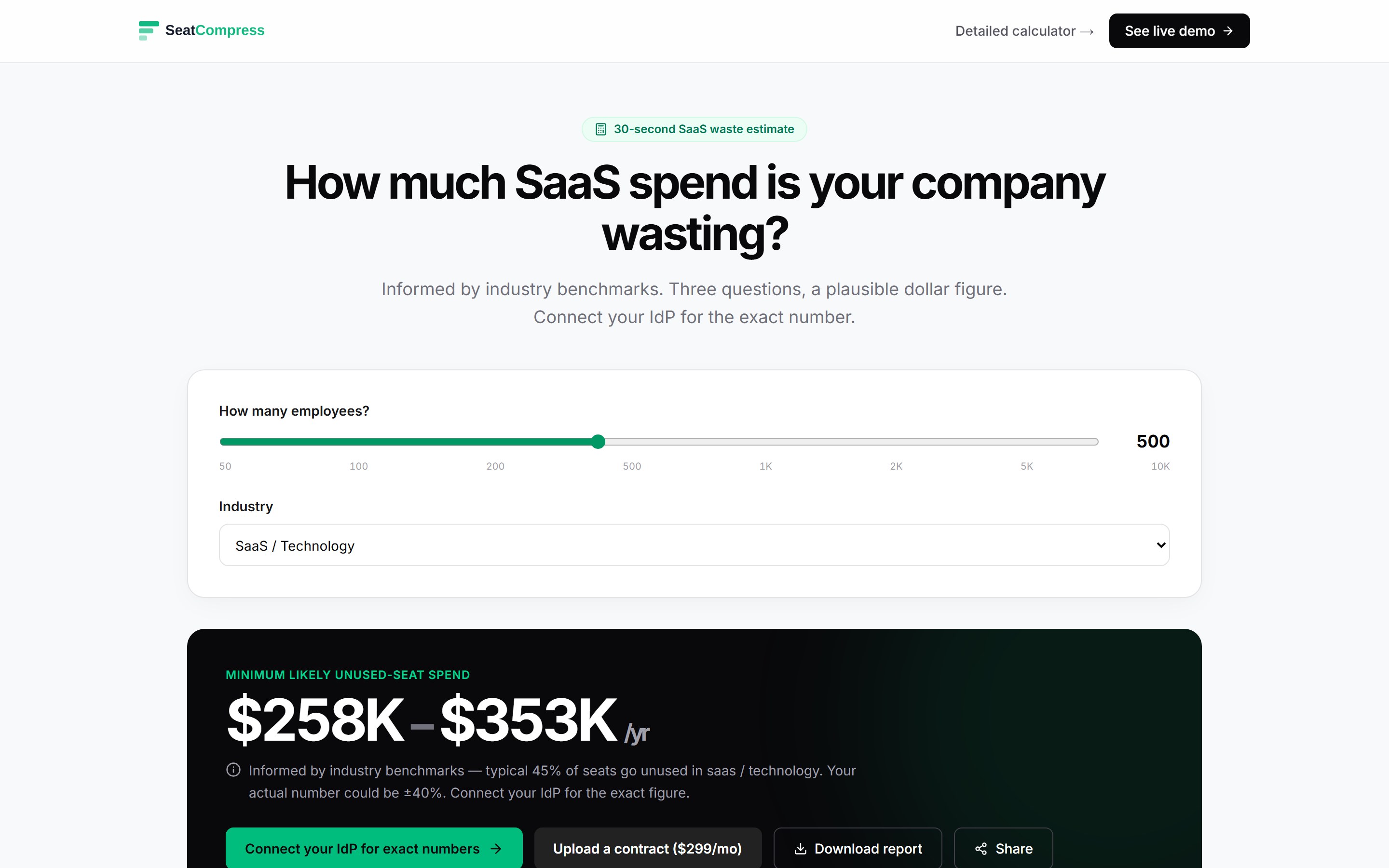
Model your own HubSpot renewal — including the Breeze compression layer, the $15K flat-fee setup floor, and the Salesforce comp — at the seat compression calculator. The HubSpot $150 published list, the $90 negotiated-average, the $105 peer p50 at 500+ seats, the 25% Breeze catalog compression, the 0.5 renegotiation realization factor, and the 0.4 deploy realization factor are all baked in.
Find your savings number in 30 seconds.
No signup, no credit card. Get the number, screenshot it, and decide if your CFO needs to know about us.