
Moveworks at $33K/Month: The IT-Support Agent Built for 10,000+ Employee Enterprises
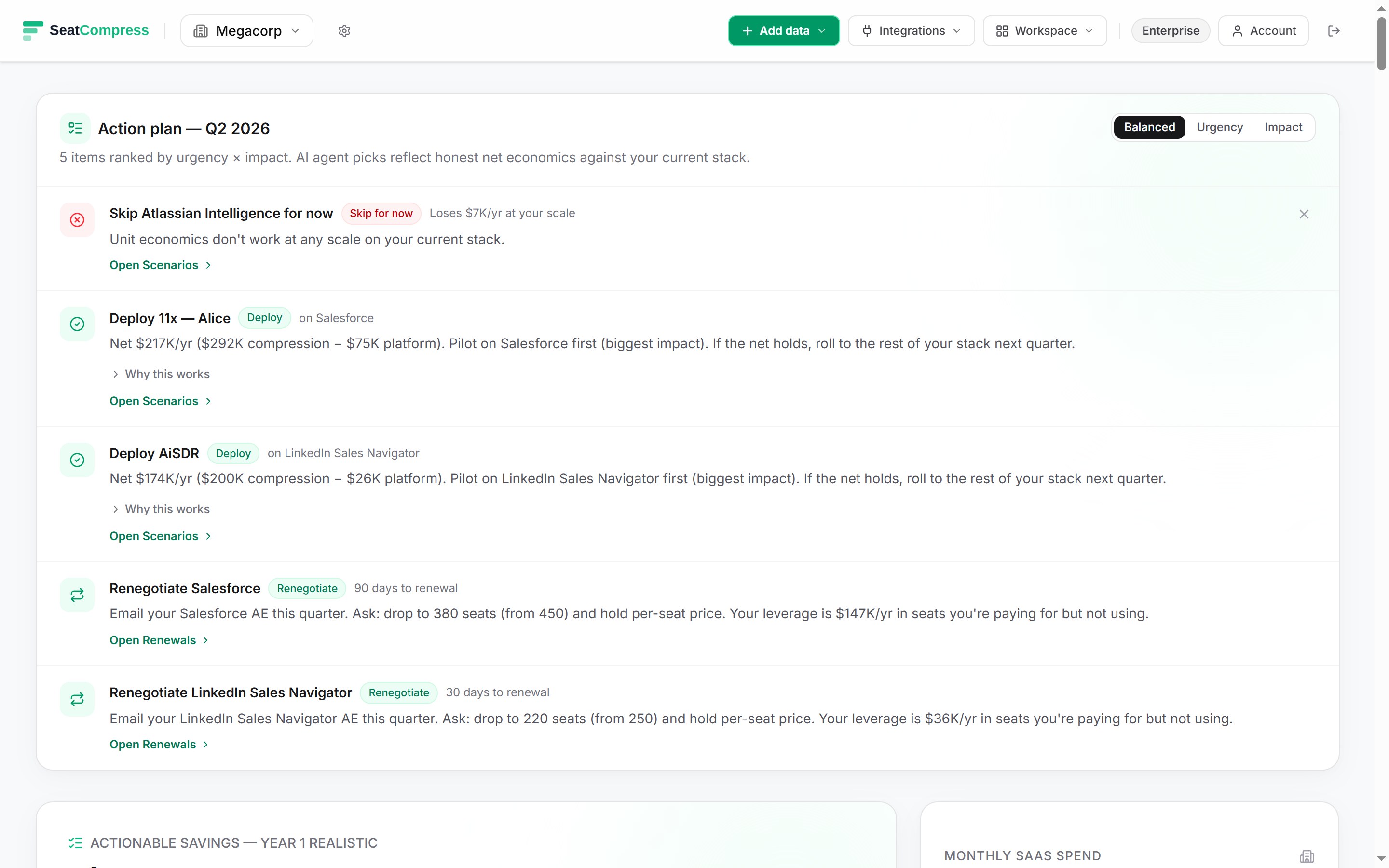
Moveworks costs $33,000 a month flat. That is not a typo, not a tier in a ladder, not a per-seat figure dressed up. It is the entry point — a number that immediately partitions the IT-support agent buyer's market into two camps: enterprises that can absorb $396K/yr before measuring a single deflected ticket, and everyone else who cannot. The thesis of this post is narrow and arithmetic: at 30% ServiceNow compression and 35% Freshservice compression in our catalog, Moveworks only clears the Year-1 hurdle once your IT-support seat base sits in the 5,000-to-50,000-employee range. Below that line, you are paying enterprise pricing for a population that cannot generate enterprise savings.
The price tag is the headline
Moveworks is, by a wide margin, the priciest IT-support agent in the SeatCompress catalog. The flat fees in this category cluster as follows: Salesforce Agentforce IT Service at $20,000/mo, Aisera at $25,000/mo, Moveworks at $33,000/mo. ServiceNow's own Now Assist is per-seat at $75/user/mo — a structurally different product that scales with your ITSM seat count rather than charging a platform fee.
The flat-fee setup floor matters here too. SeatCompress's analysis engine uses effectiveSetupCostUsd to assign a $15,000 minimum to any flat-fee agent unless the catalog carries an explicit override. The rule is max($15K, monthlyCost), so the floor lifts whenever monthlyCost itself already exceeds $15K. For Moveworks, that means Year-1 cost is $33,000 × 12 + max($15,000, $33,000) = $429,000. For Aisera, Year-1 is $25,000 × 12 + max($15,000, $25,000) = $325,000. For Salesforce Agentforce IT Service, the catalog carries an explicit $50,000 setup override, so Year-1 is $20,000 × 12 + $50,000 = $290,000.
For context, our engine zeroes out a flat-fee agent's contribution to the Year-1 hero number unless annualGrossSavings > annualAgentCost × 1.10. The ±10% band around cost is the break-even zone; outside it, the action item becomes either deploy_agent (above) or skip_agent (below). At $429K Year-1 cost, you need at least $472K of gross compression in the first year for Moveworks to register as profitable, not break-even.
What Moveworks actually compresses
Five tools in the catalog map to Moveworks impacts:
| Target | Compression % | Pricing model |
|---|---|---|
| ServiceNow | 30% | per_seat ($100/seat/mo list) |
| Freshservice | 35% | per_seat ($49/seat/mo list) |
| Slack | 15% | per_seat ($15/seat/mo list) |
| Microsoft Teams | 15% | per_seat ($12.50/seat/mo list) |
| BambooHR | 20% | per_employee |
The BambooHR row earns a footnote: BambooHR is per_employee-priced. SeatCompress's compressesByUtilization gate explicitly excludes per_employee, per_endpoint, and usage tools from generating aiReplacementSavings — the invoice is not seat-utilization-bound, so cutting agent activity does not cut the bill. The 20% figure is catalog documentation of where Moveworks deploys, not a savings lever. Same logic disqualifies it from inflating Moveworks' per-user deployment-size calculation (the Findem-class overshoot fix we shipped earlier this year).
That leaves four per-seat targets carrying the savings math. And of those four, the ServiceNow and Freshservice rows do almost all the work. Slack at 15% × $15/seat/mo and Teams at 15% × $12.50/seat/mo barely move the needle compared to ServiceNow's $100/seat/mo line item. The math says: Moveworks is a ServiceNow compression product first, a Freshservice compression product second, and a chat-app-side-deflection product a distant third.
Why mid-market cannot make this work
Run the arithmetic at a 1,500-employee company with a typical IT footprint:
- ServiceNow: 200 seats × $100/seat/mo × 30% = $6,000/mo gross compression → $72K/yr
- Freshservice: 50 seats × $49/seat/mo × 35% = $857/mo → $10.3K/yr
- Slack: 1,500 seats × $15/seat/mo × 15% = $3,375/mo → $40.5K/yr
- Teams: 0 (assume Slack-only shop)
Gross Year-1 compression: $122.8K. Against $429K of Year-1 Moveworks cost, that is a −$306K net — a textbook skip_agent action item, and not even a close call. The closest competitor in this segment, Aisera at $25,000/mo and a $325K Year-1 cost (after the $25K setup floor), fares better on absolute dollars but still loses to the math at this scale. The reason the 1,500-employee company cannot win is structural: the IT-support seat base — the ServiceNow and Freshservice users who generate the bulk of compressible spend — is too small relative to a fixed platform fee.
This is the same pattern we documented in our deep dive on why mid-market enterprises cannot unlock flat-fee AI agents. Flat-fee agents have an unlock threshold; per-user agents have a deployment-cost curve. Moveworks is the most extreme example of the former in the catalog.
Where the unlock actually sits
A 30,000-employee enterprise on ServiceNow tells a different story.
Assume the IT-support footprint scales with company size (a defensible approximation — most enterprises run ServiceNow as a tenant-wide platform with broad fulfiller and self-service licensing): 30,000 seats provisioned on ServiceNow at the $100/seat/mo list rate. That is a $36M/yr ServiceNow line item before any negotiation, which is itself unrealistic in practice — large enterprises typically negotiate well below list. But list price is the cleanest reconcilable starting point, and monthlyCost on the CompanyTool row is what costPerSeat = monthlyCost / totalSeats reads — your contracted rate, not the public list.
For the worked example, take a 30,000-employee SaaS-heavy enterprise paying a directionally estimated $80/seat/mo on ServiceNow:
- ServiceNow: 30,000 seats × $80/seat/mo × 30% compression = $720,000/mo gross compression → $8.64M/yr
That single line is twenty times Moveworks' Year-1 cost. Add Freshservice (assume a 200-seat satellite team at $49/seat/mo × 35% = $3,430/mo → $41.2K/yr) and Slack (30,000 seats × $15/seat/mo × 15% = $67,500/mo → $810K/yr), and the gross compression stack lands near $9.5M/yr against $429K of Moveworks cost. Year-1 realistic — applying the engine's 0.4 deploy-agent realization factor that smooths out the first-year ramp curve — is roughly $3.8M. The viability status flips from unprofitable at mid-market to deeply profitable at this scale.
Where exactly does the unlock sit? Solve for the ServiceNow seat count where compression matches Moveworks' cost. With Slack and Freshservice contributing roughly $850K/yr at 30K seats, ServiceNow needs to clear ~$472K − $850K = call it net-zero from ServiceNow alone before Slack + Freshservice carry the day. At more conservative assumptions — ServiceNow at $80/seat × 30% compression × 12 months — the break-even on ServiceNow alone is:
$429,000 / ($80 × 0.30 × 12) = 1,490 ServiceNow seats to clear cost from ServiceNow alone.
A directional estimate of ServiceNow ITSM provisioning at roughly 10–30% of headcount for tenant-wide deployments — not a SeatCompress framework, just a finance-team rule of thumb that captures fulfiller plus broad self-service licensing — would place 1,490 ServiceNow seats inside a 5,000-to-15,000-employee enterprise. Below that, you depend on Slack and Freshservice to pull weight; above it, ServiceNow alone clears the bar and the rest is gravy. This is the floor of the unlock band. The ceiling, predictably, is the largest enterprises where ServiceNow tenant-wide deployments push seat counts into the tens of thousands and Moveworks' 30% becomes generational compression.
Moveworks vs. Aisera vs. Now Assist
The decision is not just "Moveworks or nothing." Aisera and ServiceNow's own Now Assist compete here, and the MAX-overlap rule in the SeatCompress engine forces them into a direct shootout: if you have all three selected, the engine uses the highest compression percentage on each target tool, not the sum. Two agents that both compress ServiceNow at 30% do not compress it 60%.
Aisera ($25,000/mo flat, $325K Year-1 cost after the $25K setup floor) carries ServiceNow 25%, Freshservice 30%, Zendesk 30%, Slack 15%, Teams 15%, BambooHR 20%. The Aisera footprint is broader (it picks up Zendesk, useful for IT-meets-customer-support shops) but slightly weaker on the ServiceNow lever. At 30,000 ServiceNow seats × $80/seat/mo × 25% = $7.2M/yr from ServiceNow alone — still profitable, still by a wide margin, and at $104K lower Year-1 cost.
The Moveworks-over-Aisera case in the 5K-50K band depends on (a) the additional 5 percentage points on ServiceNow being worth ~$1.4M/yr at 30K seats (30,000 × $80 × 0.05 × 12 = $1,440,000), which dwarfs the $104K cost differential, and (b) Moveworks' Freshservice edge (35% vs 30%) for organizations running parallel ITSM stacks. At smaller scale, the cost differential dominates and Aisera wins.
ServiceNow Now Assist is the third option and the most structurally different. At $75 per fulfiller/mo, a 200-fulfiller deployment is $180K/yr — cheaper than both flat-fee options. But Now Assist is a feature pack, not a horizontal agent: it compresses ServiceNow itself (the 30% catalog figure), nothing else. No Freshservice, no Slack deflection, no cross-tool ticket triage. For ServiceNow-only shops, it is the right answer at lower deployment sizes. For organizations running Slack-as-helpdesk in parallel — most modern enterprises — it leaves the chat-app savings on the table.
The decision tree, simplified:
- < 5,000 employees: skip all three. The unlock math does not work and your IT team is small enough that ticket-deflection ROI is dwarfed by integration overhead. Renegotiate ServiceNow instead.
- 5,000–15,000 employees: Aisera or Now Assist depending on stack breadth. Moveworks is plausible but the cost premium is hard to justify until ServiceNow seats clear 1,490.
- 15,000–50,000 employees: Moveworks becomes the defensible choice. Compression delta on ServiceNow alone covers the cost premium versus Aisera, and the Freshservice edge matters if you run a dual-ITSM environment.
- > 50,000 employees: Moveworks or Aisera by stack fit. Now Assist as a complement, not a substitute.
What the math is sensitive to
Three assumptions drive the conclusion and deserve named scrutiny.
ServiceNow seat count as a fraction of headcount. The 0.5–1% range is a directional estimate, not a catalog-anchored number. ServiceNow deployments vary wildly — some enterprises license tenant-wide at $40/seat for self-service plus $100 for fulfillers, others restrict ITSM access to IT staff only. The unlock threshold moves accordingly. If your ServiceNow seat base is 0.2% of headcount, you need a 75,000-employee organization to clear the same bar a 15,000-employee org clears at 1%.
Negotiated rate vs. list rate. ServiceNow list is $100/seat/mo in the catalog. Real contracts in the gte_500 seat bucket trend lower; the $80/seat assumption used in the worked example is a directional estimate, not a peer-benchmark anchor (SeatCompress's PEPM peer-benchmark surface does not currently carry a ServiceNow row). At a $60/seat/mo negotiated rate, the break-even seat count rises from 1,490 to 1,990. The compression delta in dollar terms shrinks proportionally. This is where peer benchmarks earn their keep for tools we do carry — the Growth+ peer benchmark surface anchors your negotiated rate against the band and surfaces overcommit before you sign.
Realization factor. The 0.4 realization factor on deploy-agent action items is a Year-1 figure documented inline in the analysis engine, sourced from LeanIX and McKinsey AI-adoption ramp curves. Steady-state realization in Year 2 and beyond approaches 1.0 as the agent saturates ticket categories. The Year-1 hero number is intentionally conservative. A multi-year IRR analysis on Moveworks gets more attractive over the contract term, not less.
The CFO's Monday morning
The action is procedural, not analytical.
First, pull your ServiceNow contract. Look at two numbers: contracted seats and active fulfillers. The ratio matters less for Moveworks gating than for renegotiation — see our walkthrough on auto-renewal traps in ITSM contracts — but having both numbers on hand makes the unlock conversation faster.
Second, plug the contract into the SeatCompress calculator with Moveworks selected as the agent. If your gross compression Year-1 lands above $472K, Moveworks is a profitable action item. If it lands between $386K and $472K, you are in the ±10% break-even band and Aisera at $325K Year-1 cost is the better risk-adjusted choice. If it lands below $386K, skip both and revisit when your ServiceNow seat base scales.
Third, if you do clear the threshold, the procurement question becomes whether Moveworks' 30% compression is contractually anchored or aspirational. The catalog figure is post-derivation: a judgment classification at the vertical_replacement category cap of 0.65 (judgment-source claims are not discounted; the cap is applied directly to the stated %) — Moveworks' 0.30 is well inside that band and defensible against a CFO challenge. But contractual deflection SLAs are a different conversation than catalog modeling. Get them in writing before signing $429K of Year-1 spend on a thesis.
The bottom line: Moveworks is a real product with real economics, but the economics only work above a clear scale floor. At 5,000-to-50,000 employees with a ServiceNow tenant deployment, the unlock is decisive. Below that, the math punishes you. Above it, the math rewards you generously. The bar is structural, not negotiable, and the right answer is to recognize which side of it you sit on before you take the sales call.
Find your savings number in 30 seconds.
No signup, no credit card. Get the number, screenshot it, and decide if your CFO needs to know about us.