
ServiceNow at $100/Seat: When Moveworks and Aisera Earn Their $25K-$33K/mo Fees
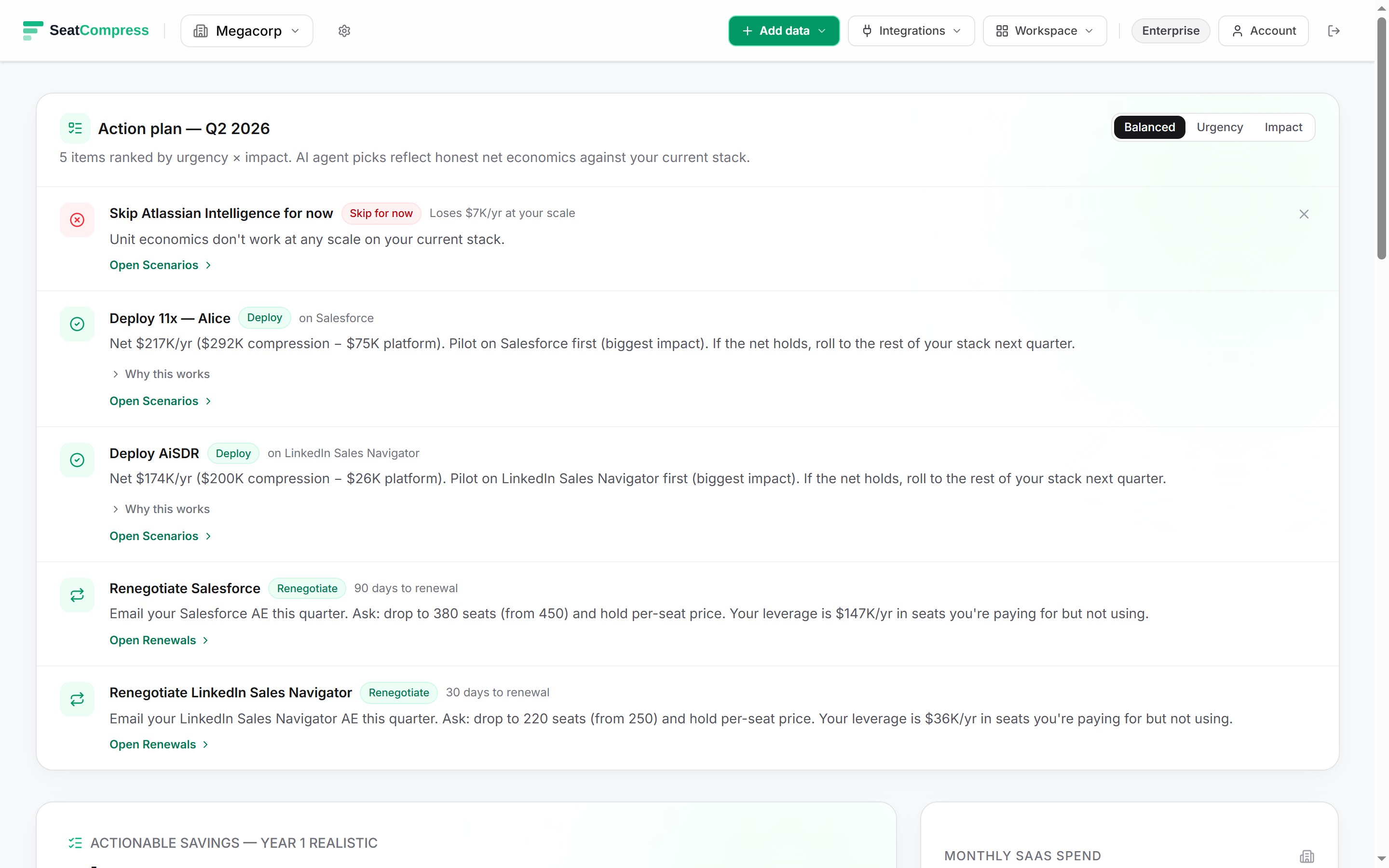
ServiceNow's $100/seat catalog list is one of the highest-leverage compression targets in the enterprise stack — three different AI agents (Moveworks at 30%, Aisera at 25%, and ServiceNow's own Now Assist at 30%) all carry sourced compression rates against it. The CFO question is never whether to deploy. It's which agent's unlock threshold matches your actual ITSM headcount, and whether the flat-fee floors penciled in the contract pass year-one viability math at your scale.
This is not a "go negotiate ServiceNow harder" post. ServiceNow's list price is what it is. The leverage is in compressing the seat count you renew against — and that means picking an agent whose monthly fee divides cleanly into the gross savings you can realistically capture in year one.
Why ServiceNow Is the Cleanest Compression Target in IT Ops
Three properties stack on top of each other.
First, the per-seat list is high. ServiceNow runs $100/seat/month on the catalog — same order of magnitude as Salesforce, well above Jira's $8.15 or Zendesk's $115. A 20% seat-count reduction on ServiceNow is worth roughly twice what the same percentage saves on Jira at equivalent headcount. The math compounds against you on the way up and for you on the way down.
Second, the agent ecosystem is unusually crowded. Most ITSM categories have one or two viable AI agents. ServiceNow has at least four with non-zero, defensible compression rates:
- Moveworks — 30% on ServiceNow, $33,000/mo flat
- Aisera — 25% on ServiceNow, $25,000/mo flat
- ServiceNow Now Assist — 30% on ServiceNow, $75/user plus a $1,875/mo platform fee (per-user-dominant pricing)
- Salesforce Agentforce IT Service — 50% on ServiceNow, $20,000/mo flat + $50,000 setup
Four agents competing on the same target means CFOs have real optionality. It also means three of them are flat-fee, which is where the unlock-threshold math gets interesting fast.
Third, ServiceNow's pricingModel is per_seat, which means SeatCompress's analysis engine treats it as a legitimate compression target. PEPM-priced tools (Workday, BambooHR, Rippling) and usage-priced tools (Datadog, Segment) get zeroed out for unused-seat savings entirely, because the bill doesn't divide cleanly into seats you can drop. ServiceNow's bill does. Every seat you stop renewing is $100/month back in the operating budget.
The Flat-Fee Floor Math (and Why It Excludes Most Mid-Market)
Here's the part most vendor decks gloss over: Moveworks at $33,000/mo is $396,000/year, before setup. To pencil at year-one viability — meaning gross savings × 0.4 realization factor must exceed the all-in agent cost — you need a ServiceNow footprint big enough that 30% compression on active seats clears the floor.
The arithmetic, using SeatCompress's published realization factor of 0.4 on deploy_agent actions:
year-1 gross savings = active_seats × 0.30 × $100 × 12 × 0.40
                     = active_seats × $144
year-1 agent cost    = $33,000 × 12 + $33,000 setup (flat-fee floor mirrors monthly)
                     = $429,000
break-even           = $429,000 / $144 ≈ 2,980 active seats
That's the gross break-even on ServiceNow alone — roughly 2,980 active ServiceNow seats before Moveworks recovers its flat fee against the ITSM line item. In practice Moveworks' secondary impacts (Slack 15%, Teams 15%, BambooHR 20%, Freshservice 35%) pull the all-in break-even lower, but BambooHR is PEPM-priced and gets zeroed by the analysis engine's pricing-model gate — so the only secondary contributors that actually move the floor are Slack, Teams, and Freshservice. The honest framing for a CFO: budget Moveworks on the ServiceNow break-even and treat the chat-app compression as upside, not as the underwriting case.
A 2,000-employee mid-market company typically runs 200-500 ServiceNow seats. They are not the buyer for Moveworks. The buyer is a 15,000-employee enterprise with 3,500 active ServiceNow seats whose CFO has watched their IT-ops line item compound 18%/year for three renewals running.
Aisera at $25,000/mo softens this. Same math:
year-1 gross savings = active_seats × 0.25 × $100 × 12 × 0.40
                     = active_seats × $120
year-1 agent cost    = $25,000 × 12 + $25,000 setup
                     = $325,000
break-even           = $325,000 / $120 ≈ 2,710 active seats
Aisera's lower fee partly offsets its lower compression rate. The floor lands in the same neighborhood — call it 2,700 active ServiceNow seats for genuine net-positive year-one viability — but the risk profile is different. Aisera is the conservative choice if you're at 2,500-3,500 seats and want a thinner unprofitable margin if the deployment underperforms.
Now Assist: The Per-User Agent That Changes the Calculus
ServiceNow's own Now Assist breaks the flat-fee pattern. Pricing is roughly $75/user/month with a modest $1,875/mo platform fee on top, and no setup floor (per-user-dominant agents resolve to $0 setup in SeatCompress's effectiveSetupCostUsd logic — services overhead is minimal when there's no flat-fee provisioning). The per-user component is the marginal cost driver; the platform fee is a fixed overhead that adds $22,500/year regardless of operator count.
This matters because Now Assist is the only ServiceNow-targeting agent that's viable at sub-2,000-seat scale.
year-1 gross savings per seat = 0.30 × $100 × 12 × 0.40 = $144
year-1 agent cost per seat    = $75 × 12 = $900
The headline looks brutal — $900 in agent cost to produce $144 in year-one realized savings per seat. But this is misleading because Now Assist is priced per agent seat, not per ServiceNow seat. If you deploy Now Assist to 100 IT operators who handle tickets for 2,000 employees, your cost is $112,500/year ($90,000 per-user + $22,500 platform fee) and your gross compression target is 30% of 2,000 ServiceNow fulfiller seats — not 30% of the 100 agent users.
In other words, Now Assist's per-user fee is a service overhead on the IT-ops team, not a per-compressed-seat fee. At small scale (300-1,500 ServiceNow seats, 30-100 IT operators) this is the only agent in the category that pencils. Above 2,000 ServiceNow seats, Moveworks or Aisera's flat fees become cheaper on a per-compressed-seat basis.
This is the inflection point CFOs miss when they hear "flat-fee enterprise AI." The fee structure is a feature, not a bug — it's the pricing model that lets a vendor commit margin on a deployment they couldn't underwrite per-seat. The flip side is that flat fees require a minimum scale to justify, and Now Assist is what fills the gap below that scale.
Agentforce IT Service and the 50% Outlier
Salesforce's Agentforce IT Service is the strangest line in the catalog: 50% compression on ServiceNow, $20,000/mo flat, plus $50,000 setup. Half off ServiceNow seats from a Salesforce product targeting a competitor's platform.
The compression rate (0.50) sits below the vertical_replacement category cap of 0.65 in SeatCompress's deriveCompressionPct (applied after sourced-claim discount factors), so it remains within the defensible band — but it's the most aggressive ServiceNow-targeting rate in the catalog. The fee structure tells you Salesforce is pricing this as a strategic land grab — recoup the $50K setup through a multi-year ServiceNow displacement narrative, then upsell into the broader Agentforce platform.
For a CFO, the right way to underwrite this is to assume the 50% rate is achievable but stay disciplined about the realization factor. SeatCompress's canonical year-one realization factor on deploy_agent actions is 0.4 — that's what the engine applies and what you should anchor on. If you want to run a more conservative analyst overlay (not the SeatCompress default) reflecting that Agentforce IT Service is a younger product without the deployment maturity of Moveworks or Aisera, you can model at a lower factor in your own underwriting and tighten the break-even further. Either way, this is a side calculation; the published methodology number is 0.4.
Pick Agentforce IT Service if you're already on Salesforce broadly and the political cost of expanding the Salesforce footprint is lower than the integration cost of standing up Moveworks. Pick Moveworks if you're a ServiceNow-native shop and want the deepest ITSM-specific integration. Pick Aisera if you want flat-fee predictability with a thinner failure-mode margin. Pick Now Assist if you're below the roughly 2,700-2,980-seat threshold the flat-fee agents need to clear.
Worked Example: A 12,000-Employee SaaS Company at ServiceNow Renewal
Synthetic persona. CFO inherits the following stack at the 90-day pre-renewal mark:
- ServiceNow: 3,200 contracted seats, 2,750 active, $100/seat catalog, $320,000/month, $3.84M/year ACV
- Slack: 11,000 seats, $15/seat, $165K/month
- Microsoft Teams: 11,000 seats, $12.50/seat, $137.5K/month
- Freshservice: 0 seats (not deployed)
- BambooHR: 12,000 employees, $17 PEPM, $204K/month
ServiceNow alone is $3.84M/year. The 450-seat unused-seat gap (3,200 contracted minus 2,750 active) is the first lever — that's $540,000/year in pure waste recoverable at renewal under the seat-reduction track, before any AI agent enters the picture. Apply the 0.5 realization factor on renegotiation per SeatCompress's realisticActionableSum and the year-one realized number is $270,000.
Now layer in Moveworks. The compression model:
agent compression on ServiceNow      = 0.30 × 2,750 active = 825 ServiceNow seats
monthly savings on ServiceNow        = 825 × $100         = $82,500/mo
annual gross                         = $82,500 × 12       = $990,000/yr

secondary impacts (Moveworks):
  Slack at 0.15  = 0.15 × 11,000 × $15 × 12 = $297,000/yr
  Teams at 0.15  = 0.15 × 11,000 × $12.50 × 12 = $247,500/yr
  BambooHR at 0.20 — pricingModel is per_employee → ZEROED by the compressesByUtilization gate

total annual gross                   = $990,000 + $297,000 + $247,500 = $1,534,500
year-1 realized (× 0.4)              = $613,800
year-1 agent cost                    = $33,000 × 12 + $33,000 = $429,000
year-1 net contribution              = $613,800 − $429,000 = $184,800
Moveworks pencils. Just barely on ServiceNow alone (that line item would net negative against the flat fee), but the Slack + Teams secondary compression carries the deal across the line.
The BambooHR zero-out matters. Moveworks' catalog impact says 20% on BambooHR, but BambooHR is per_employee PEPM-priced — the bill doesn't shrink when seats stop logging in. SeatCompress's engine pre-filters this in the analysis layer, which is the same defense that caught the Findem $2.4M demo overshoot before the engine fix landed. If your vendor deck claims year-one savings on PEPM tools, ask which line items they're attributing the savings to. The honest answer is none of them, at the seat layer; renegotiation against PEPM tools is a separate exercise we've written about in our PEPM rate renegotiation playbook.
Net for this CFO: the renegotiation track alone (drop 450 unused seats, renew at 2,750 contracted) saves $270,000 realized. Layering Moveworks on top adds another $184,800 net contribution. Total year-one impact: roughly $455,000 realized against a $3.84M ServiceNow line item — a 12% reduction in the IT-ops spend category, sourced from one renewal and one agent deployment.
Run your own version of this stack through the SeatCompress calculator — the per-tool agent picker handles the MAX-overlap rule across all four ServiceNow agents and surfaces which one wins net contribution at your seat count.
The Renewal Calendar Is the Forcing Function
ServiceNow renewals are notoriously hard to move mid-cycle. Auto-renew clauses with 60-90 day notice windows are standard, and the contract's seat-floor language frequently locks you into the previous high-water mark even after layoffs or efficiency programs. We've covered this dynamic at length in The hidden cost of auto-renewal clauses.
The practical sequence:
- At T-180: confirm the contract's notice window and seat-floor terms. If you missed the notice window, this renewal cycle is locked — start the work for next year.
- At T-120: pull Okta or Azure AD provisioning data against ServiceNow to surface the active-seat number. This is the negotiation anchor. SeatCompress's
resolveSeats(t)resolution order iscontractedSeats ?? provisionedSeats ?? totalSeats— the IdP-sourced number wins when contracts haven't been re-uploaded. - At T-90: model Moveworks, Aisera, Now Assist, and Agentforce IT Service against your specific active-seat count. The right answer depends on which side of the roughly 2,700-2,980-seat break-even you sit on.
- At T-60: notify ServiceNow of your renewal intent at the reduced seat count. The conversation isn't "we want a discount" — it's "we're deploying an AI agent that compresses fulfiller workload by 30%, here's the seat number we'll commit to." Vendors respond differently to a usage-justified seat reduction than to a generic procurement ask.
- At T-30: lock the agent contract conditionally on the ServiceNow renewal landing at the target seat count. Don't let either vendor close in isolation.
The bottom line: ServiceNow at $100/seat with three or four viable compression agents is a CFO playbook, not an IT decision. The agent selection is determined by your active-seat count, your renewal notice window, and your willingness to underwrite year-one realization at 0.4 of theoretical gross. Below roughly 2,700 active seats, Now Assist is the only agent that pencils. Above 2,700-2,980, Moveworks or Aisera become competitive on a flat-fee basis. Above 5,000, the flat fees become embarrassingly cheap per compressed seat — which is the point where most enterprise ServiceNow contracts sit and the point where this category produces the largest absolute dollar savings in the entire SaaS stack.
The renewal date is the forcing function. The agent selection is the lever. The math is the same either way.
Find your savings number in 30 seconds.
No signup, no credit card. Get the number, screenshot it, and decide if your CFO needs to know about us.