
Free vs Starter vs Growth: Which SeatCompress Tier Fits Your Stack
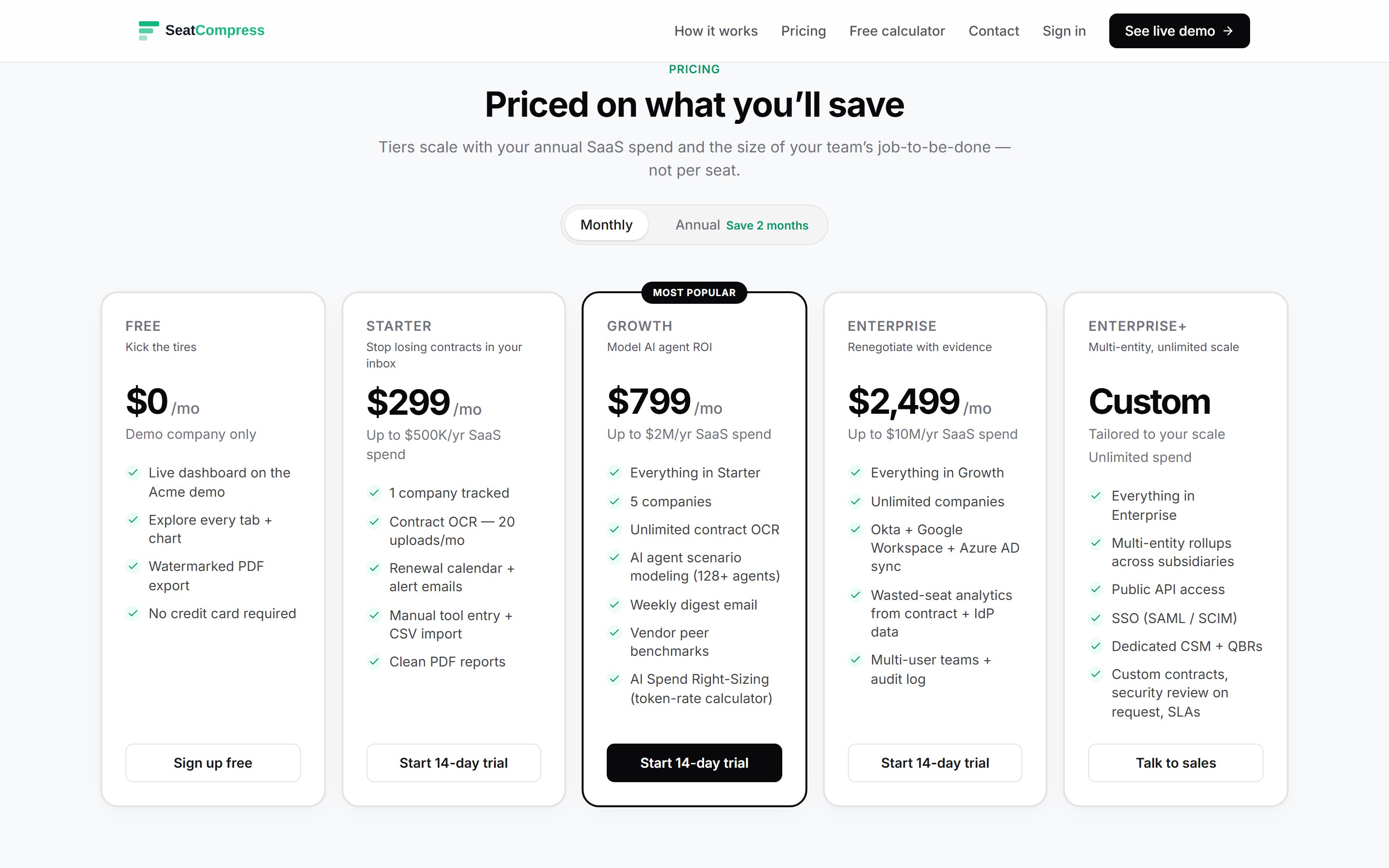
Most pricing-tier articles read like a sales deck. This one doesn't. The right SeatCompress tier is mechanical: it's whichever first matches your actual spend, company count, and feature-gate needs. Aspirational doesn't enter the math.
Here's the ladder in one paragraph so you can stop reading early if the answer is obvious. Free is signup-only — you see the shared demo company and the PDF carries a diagonal "DEMO" watermark. Starter at $299/mo ($2,990/yr) gets you one company, a $500K annual spend cap, and 20 contract uploads per month. Growth at $799/mo ($7,990/yr) lifts that to 5 companies, a $2M spend cap, unlimited uploads, and unlocks scenarios, peer benchmarks, renegotiation playbooks, and the AI-Spend right-sizing calculator. Enterprise at $2,499/mo ($24,990/yr) goes to unlimited companies, $10M cap, 25 members per company, and adds the IdP integration bundle (Okta + Google Workspace + Azure AD), multi-user roles, and the audit log. Annual saves you two months on every tier. There's a 14-day trial, one per user, with a three-layer abuse defense — cancel-and-resubscribe doesn't reset it.
That's the buyer's guide in 180 words. The rest of this post is the decision tree behind it and the edge cases that catch finance teams off-guard.
Free is a sales demo, not a tool
The Free tier is a discovery surface. You can log in, click around the shared demo company (Acme, ~22 tools, ~$2.4M of seeded annual spend), export a PDF with a diagonal watermark, and run the public ROI calculator without any signup at all. What you cannot do on Free: add a real company, upload a contract, persist a single CompanyTool row, or download an unwatermarked PDF. The matrix is explicit — canMutate: false on Free, zero companies allowed, zero contract uploads per month.
Why does Free exist at all? Two reasons. First, the calculator is a top-of-funnel lead-capture mechanism — paste in your stack, see the year-1 number, drop your email for the PDF. Second, the shared demo is the only way to evaluate the dashboard, scenarios, renewals tab, and AI Spend panel without paying. The watermark is the trust signal: the demo is real product, not a marketing screenshot, but you're looking at someone else's seeded data.
If you're reading this and asking "could we run on Free permanently" — no. The instant you want to attach a real contract PDF or get a renewal alert on your own Salesforce row, you need at minimum Starter. Free is a brochure.
Starter pays for itself on one Salesforce renewal
Starter is the entry point at $299/mo. One company, $500K annual spend cap, 20 contract uploads per month, single user. It does not include scenarios, peer benchmarks, playbooks, the AI Spend calculator, or any IdP integration. What it does include is the core loop: contract OCR → renewal calendar → utilization analysis → exportable PDF.
The math on whether Starter pays back is short. A Salesforce Enterprise seat at the Vendr median lands around $115/seat/mo in the 100-499 seat band and $100/seat/mo at 500+. If you have 200 Salesforce seats provisioned and 145 active (a 27% utilization gap — typical, not aggressive), the unused-seat waste runs at 55 seats × $115 × 12 = $75,900/yr at list. Even if you only recover half of that at renewal — and the engine's renegotiate realization factor is exactly 0.5, sourced from public Vendr / Spendflo / Tropic case-study aggregates — you're at $38K of realized savings off a single tool against a $2,990 annual subscription. That's a 13× payback before the second tool gets touched.
Starter's hard ceiling is the $500K annual spend cap. The cap counts the sum of monthlyCost × 12 across your CompanyTool rows. A 12-person startup running Slack + Notion + Linear + Figma + GitHub + Google Workspace will sit comfortably under $200K and never hit it. A 200-person company with Salesforce, Outreach, Gong, Slack, Zoom, GitHub, and Datadog is already past $500K — Starter is structurally wrong, and the analyze endpoint will return a 403 over-cap response with requiredTier: "growth".
This is the first mechanical filter. If your raw annual SaaS spend is over $500K, skip Starter entirely.
Growth is the scenario / benchmark / playbook tier
Growth at $799/mo is where SeatCompress becomes a finance-strategy tool instead of a contract tracker. The five features it unlocks aren't garnishes — they're the analytical surfaces a CFO actually presents in a board meeting.
Scenario comparison. Persist up to 5 named scenarios per company ("Deploy Sierra and skip Decagon," "Renegotiate Salesforce to Pro," "Hold the line on AI agents through Q4"). The scenario comparison view replays each one against your current stack and produces a side-by-side year-1 number. The engine uses limit: 100 on action items in comparison mode versus limit: 5 on the default dashboard — because a scenario commit is a whole-year decision, not a this-quarter prioritization.
Peer benchmarks. Every per-seat tool in your stack gets a ±10%-of-p50 band comparison against the VendorBenchmark table — 624+ rows keyed on (saasToolId, seatBucket) where the buckets are lt_25 / 25_99 / 100_499 / gte_500. A Salesforce seat at $145 in the 25-99 band shows red over the $130 p50 (outside the ±10% band); the same $145 in the 100-499 band where p50 is $115 shows an even larger over-band delta plus a prescriptive "drop to Pro · save $X/yr" chip when a cheaper tier exists at high mapping confidence.
Renegotiation playbooks. Per-row "Playbook" button on the Renewals tab generates a Sonnet-extracted email subject + body + talking points + leverage summary using your CompanyTool + matching VendorBenchmark + tier mapping as input. Anti-fabrication contract baked in — every number the LLM cites has to trace back to your actual contract or the seeded benchmark row. 7-day cache keyed on a SHA-256 hash of the input bundle so you can regenerate after a price change without burning tokens on a no-op.
AI Spend right-sizing. The five-lever calculator — model swap, prompt cache, batch API, enterprise rate, right-size context — runs over your Anthropic admin-key actuals (BYO key, AES-256-GCM encrypted at rest) and produces sequentially-stacked savings. No additive double-counting; each lever operates on residual spend.
Weekly digest. Monday morning email with renewal pressure, action items, and stack drift.
The Growth spend cap is $2M, four times Starter. The 5-company allowance matters for finance teams running a holdco structure or evaluating an acquisition target's stack without merging it into the parent. A single user; multi-user requires Enterprise.
If your spend is between $500K and $2M annually, or you need scenarios / benchmarks / playbooks / AI Spend for a single entity, Growth is the answer. If your spend is between $500K and $2M but you genuinely don't need any of those five features — you're a Starter customer who happens to spend a lot. That's an edge case; in practice, $1M+ stacks have always wanted at least scenarios.
Enterprise is the IdP + multi-user + audit-log tier
Enterprise at $2,499/mo is sales-priced for what it gates, not what it adds in raw feature count. Three things move at this tier.
IdP integration bundle. Okta + Google Workspace + Azure AD all unlock together — one idpIntegration bit in the access matrix, not three separate adapters. This is the feature that closes the seat-compression loop: contract OCR fills the contractedSeats column, IdP sync fills provisionedSeats and activeSeats, and the delta is the wasted-spend headline. Without an IdP, you're hand-typing activity counts. With one, the dashboard refreshes daily and the renewal-alert cron fires on real utilization data.
Multi-user with roles. Up to 25 members per company, role-aware authorization (requireRole), per-company billing via getEffectiveAccess so a Member of someone else's Enterprise company gets the company tier (not their own personal tier). This is non-trivial: a finance analyst added to a CFO's Growth-tier company would otherwise see a Starter view because their personal Subscription row is Free.
Audit log. Every state-mutating action — playbook generation, tool create/update/delete, scenario save, member invite, contract upload — writes an AuditLog row visible on /dashboard/audit. Read API is Enterprise+ gated, write side fires on every tier. The audit log surface is increasingly a SOC 2 / SOX expectation; we built it as a feature, but the boring procurement reality is that it's the thing that closes deals with regulated buyers.
Enterprise spend cap is $10M. Unlimited companies. If you're a parent company with three operating subsidiaries each running $2M of SaaS, Enterprise is the floor. If you're a single-entity finance team but your SOC 2 auditor wants an audit log, Enterprise is the floor. If you're a 5,000-employee company and you genuinely don't need Okta sync, you're an edge case — and we'd ask why you haven't unified provisioning yet.
Enterprise+ (custom-tier) adds the api and sso flags. The DB row gets tier: "custom", the Stripe Customer Portal won't allow plan switch (Price ID isn't in the whitelist), and /account auto-renders a mailto link instead of an upgrade button. Pricing is sales-led; this is the public-API and SAML-SCIM tier for the cases where you want to feed SeatCompress data into a downstream BI tool or enforce SSO at the org level.
Worked example: a 12,000-employee SaaS company on $4.8M of annual stack
The reason this post exists is that real finance teams don't fit cleanly into one tier. They have to read across two — usually Growth-vs-Enterprise — and decide which gate matters.
Take a synthetic 12,000-employee mid-enterprise SaaS company. $4.8M annual SaaS spend across roughly 40 tools. Two operating entities (US + EMEA) and a CFO who wants the finance manager, two senior analysts, and the IT director all on the platform.
Spend cap check. $4.8M is over Growth's $2M cap. Mechanical filter: Enterprise.
Company count check. Two entities. Growth's 5-company allowance covers it. Enterprise also covers it.
User count check. Four named users plus a couple of view-only audit roles. Growth allows one user per company. Enterprise allows 25. Mechanical filter: Enterprise.
IdP check. The company runs Okta. They want daily-refreshed activeSeats data instead of hand-typed counts. The contract-only path gives them renewal alerts and spend tracking; the IdP path gives them the wasted-seat headline number — the contractedSeats − activeSeats delta. Mechanical filter: Enterprise.
Any one of three filters lands them on Enterprise. They're not aspirationally choosing it; the tier is forced by the spend, the users, and the IdP all independently.
What does the math look like once they're on it? Their Salesforce row alone — 400 seats provisioned, 310 active, $115/seat/mo list — is $124K/yr of unused-seat waste. At the 0.5 renegotiation realization factor that's $62K of realistic year-1 savings. Their Zendesk row at 220 seats, $115/seat/mo, with Intercom Fin or Decagon as the deployable AI agent at 50% (Intercom Fin) to 65% (Decagon) compression on the catalog — that's another $150K-$200K of theoretical seat replacement before the 0.4 deploy realization factor. The Growth-tier scenarios feature would let them model "deploy Sierra" vs "deploy Decagon" vs "renegotiate Zendesk to Suite Team" and compare year-1 nets side-by-side; the Enterprise-tier audit log writes a playbook.generated row every time they pull a vendor playbook so finance can produce the trail to compliance later.
Their Enterprise subscription is $24,990/yr annual. Against $62K of realized Salesforce renegotiation alone — before the support stack moves, before the AI Spend levers run on their Anthropic actuals — the payback is single-renewal. Two renewals if you want to be conservative. The tier price has effectively never been the decision-relevant number for a 12K-employee company; the decision-relevant number is whether they can present the board the seat-compression math without a junior analyst hand-stitching spreadsheets.
The Monday-morning decision
If you've read this far, the call is mechanical. Pull your last 12 months of SaaS invoices, sum the annual contract values, count your operating entities, count the named users who'd touch the platform, and check whether you run an IdP.
If raw spend is under $500K and you're a single entity with one user: Starter. Renegotiate one Salesforce or Zendesk contract and the subscription pays for itself nine times over in year one.
If spend is $500K–$2M, you want scenarios or peer benchmarks or playbooks or AI Spend right-sizing, and you're still single-entity / single-user: Growth. The $799/mo gate is the analytical-tooling gate, not the spend gate per se.
If spend is over $2M, or you have multiple operating entities, or you need 2+ users, or you run Okta / Workspace / Azure AD and want daily-refreshed utilization: Enterprise. There is no Growth-with-add-ons path; the IdP bundle and multi-user are gated together intentionally because they're how a finance org actually operates, not how a single CFO does.
If you need a public API or org-wide SAML SSO: Enterprise+, sales-led.
Don't start on Free expecting it to scale. Don't pay for Starter if you'll be over the cap by month two. Don't pay for Growth if you'll need IdP by quarter end. The 14-day trial is one-per-user and the abuse defense is real — pick the right tier the first time, run the trial against your actual stack, and let the year-1 number make the case to your finance committee. The product is built to be mechanical at the tier-fit level so that the only judgment call left is the one that matters: which renegotiation goes first.
Find your savings number in 30 seconds.
No signup, no credit card. Get the number, screenshot it, and decide if your CFO needs to know about us.