
ThoughtSpot Spotter at $25/User: The Analytics Agent That Compresses Tableau 50%
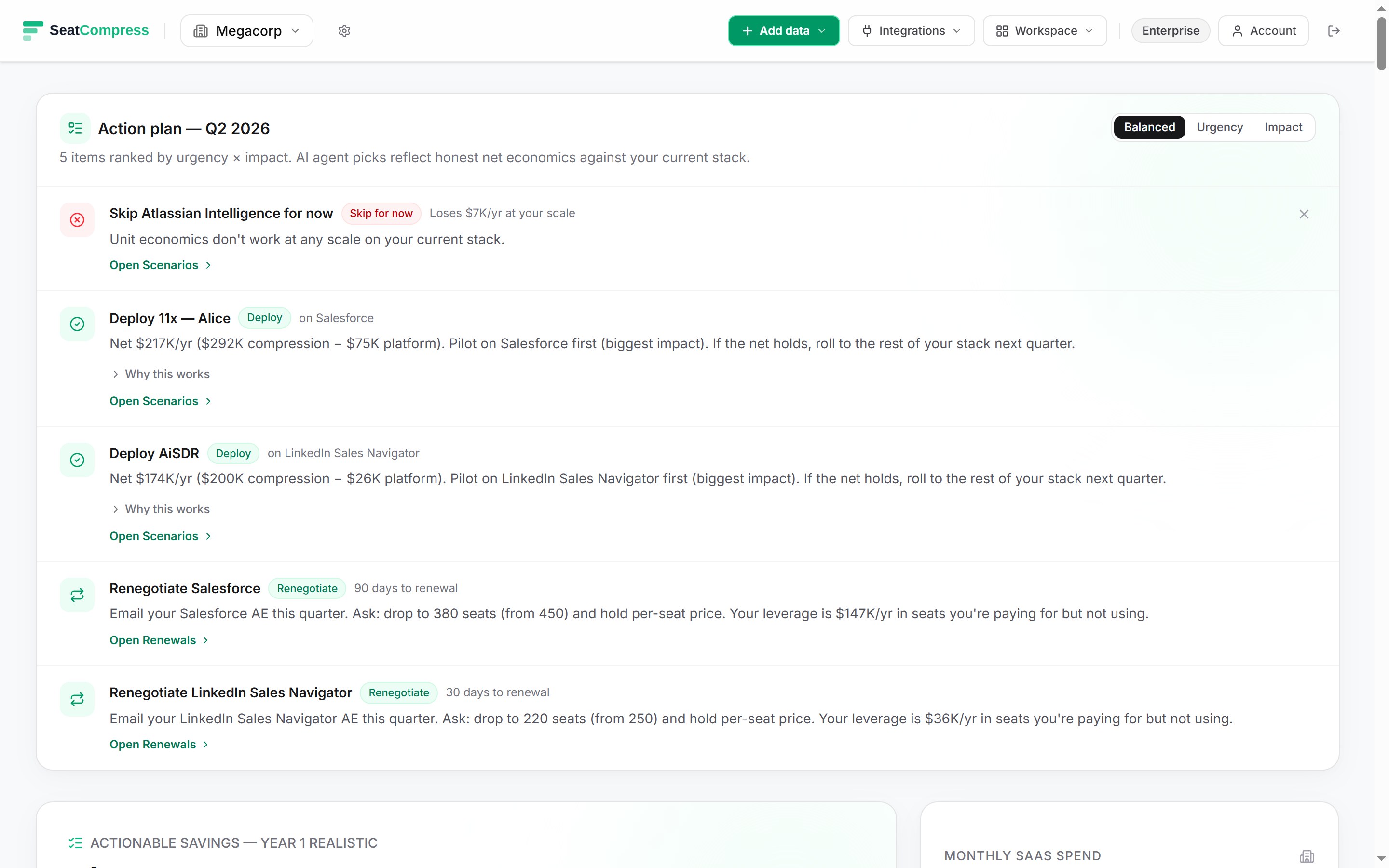
Most AI agent categories produce a wide spread of compression rates — some replace 60% of a tool's seats, most replace 15-30%, plenty replace nothing. The analytics category is the outlier. ThoughtSpot Spotter, priced at $25/user (dropping to $20 at the 100-seat enterprise threshold), carries the most aggressive per-tool compression rates the catalog has assigned to any analytics agent: Tableau 50%, Looker 45%, Power BI 35%, Metabase 30%. For CFOs at 5,000+ employee enterprises sitting on six- and seven-figure BI contracts, that math is worth a Monday-morning meeting.
Why analytics seats compress harder than most categories
The thesis behind compression percentages is mechanical, not aspirational. A seat compresses when the AI agent does the work the human-facing license was bought for. In analytics, the work is overwhelmingly read-side: a finance analyst pulls a dashboard, a product manager asks a question of the data, a sales ops lead exports a CSV. Spotter's natural-language query interface answers those questions directly. The Tableau seat that existed to let someone open a workbook and filter it is exactly the seat a natural-language agent replaces.
Compare that to the customer support category, where Decagon compresses Zendesk 65% and Sierra 60%. Those numbers exist because tickets are a closed-form problem with a deflection rate you can measure. Analytics seats are messier in concept but cleaner in compression: the agent doesn't need to "resolve" anything. It just needs to surface the number. That's why Spotter's 50% on Tableau is in the same range as Intercom Fin's 60% on Intercom — the work is read-shaped.
The catalog's other analytics agents land lower for visible reasons. Julius AI sits at 20% on Tableau and Looker. Vanna AI lands at 20% on Looker, 20% on Tableau, 15% on Metabase. Wren AI: 20% on Looker, 15% on Tableau. These are useful tools, but their compression rates reflect that they're narrower in scope — text-to-SQL helpers and analyst sidekicks, not workbook-replacement agents. Databricks Genie Code compresses dbt Cloud 20% and stays inside the data-engineering layer. Only Spotter is positioned as a true seat-replacement for the BI-consumer license.
The methodology behind those numbers is explained in why we source every compression percentage. The short version: vertical-replacement agents like Spotter cap at 0.65, and every claim is discounted by source type before it lands in the catalog.
The Tableau math at enterprise scale
Tableau's catalog list price is $75/seat/month. A 500-seat deployment runs $37,500/month, or $450,000/year. That's not the largest line on most finance teams' SaaS ledgers — Salesforce at $100/seat or Splunk at $150 base will outweigh it at most enterprises — but it's a single, undifferentiated, per-seat-priced contract that compresses cleanly.
The Spotter math at that deployment size:
- 500 active Tableau seats × $75/seat/mo = $37,500/mo gross Tableau cost
- Spotter compression on Tableau: 50%
- AI-replaceable seats: 250
- Gross monthly compression: 250 × $75 = $18,750
- Gross annual compression: $225,000
Agent cost at 500 users on Spotter:
- 500 users is above the 100-user enterprise threshold, so the rate is $20/user/mo, not $25
- 500 × $20 = $10,000/mo = $120,000/year
- Setup cost: $0 (per-user-priced agents default to $0 setup in the engine; enterprise services agreements occasionally add an implementation fee, but the catalog default reflects the published pricing)
Year-1 pre-discount net: $225,000 gross savings − $120,000 agent cost = +$105,000 (before applying the 0.4 first-year realization factor the engine applies to deploy actions). Apply that discount and the realistic Year-1 number is $90,000 realized savings (250 × $75 × 12 × 0.4) against $120,000 in agent cost — Year-1 doesn't fully clear (~$30K shortfall), but Year-2 onward runs at the full +$105K/yr net at steady state.
That's the honest framing CFOs need. The headline gross number is real. The Year-1 hero is smaller because adoption ramps, change management has friction, and analysts don't abandon their saved workbooks on day one. The realization discount is sourced from LeanIX and McKinsey AI-adoption ramp curves: first-year realization typically lands between 30-50% of steady-state ROI. The engine uses 0.4 on deploy actions to stay in the conservative half of that band.
Where Spotter compresses harder than the headline
Tableau gets the headline because $75/seat at enterprise volume is the largest absolute dollar opportunity. But the per-percent compression number is highest on Looker — 45% — and Looker's list price is $60/seat/mo. That's a $32 monthly compression per replaced Looker seat versus $37.50 per replaced Tableau seat, narrower in absolute dollars but with broader seat populations at many data-stack-modern enterprises. A 1,000-seat Looker deployment:
- 1,000 × $60 × 0.45 × 12 = $324,000 gross annual compression
- Spotter at 1,000 enterprise-rate users: $20 × 1,000 × 12 = $240,000/year
- Year-1 pre-discount net: +$84,000 (before applying the 0.4 realization factor), or roughly $129,600 realized against the same $240K cost after the 0.4 factor — meaning Year-1 doesn't fully clear at this scale, but Year-2 onward runs at +$84K/yr at steady state.
Power BI is the harder case. Microsoft's list price for Power BI Pro is $14/seat/mo. Even at Spotter's 35% compression rate, the per-replaced-seat economics are $4.90/mo — and Spotter at $25/user retail (or $20 enterprise) costs more than the seat it's replacing. For Power BI shops, the Spotter business case only works at very large deployments where the seat-count math swings: 5,000 Power BI seats × $14 × 0.35 × 12 = $294,000/year gross, against $20 × 5,000 × 12 = $1.2M Spotter cost. That doesn't clear. The catalog flags this as the structural challenge with low-list-price tools, and it's the same shape that made per-resolution support agents only viable above specific ticket-volume thresholds.
The takeaway: Spotter's strongest economic case is at Tableau and Looker shops. Power BI shops should treat the compression percentage as catalog truth but the dollar opportunity as small.
What ThoughtSpot Spotter actually does (and doesn't)
Spotter is a natural-language analytics agent built on ThoughtSpot's existing search-driven BI platform. The compression thesis works because the agent doesn't ask analysts to abandon their data warehouse — it queries the same tables Tableau and Looker connect to. The replaced seats are the consumer seats: the executives, sales managers, product managers, and operations leads who use a BI license a few times a week to answer a specific question. Those users don't need the full workbook-authoring surface area. They need the answer.
The seats that don't compress are the analyst seats: the people who build the dashboards, define the calculated fields, and own the semantic layer. Those licenses stay on Tableau or Looker. The 50% number is a population-weighted figure assuming the typical enterprise mix — roughly 50% consumer, 50% creator. Companies with a heavier creator population will see less compression; companies with a heavier consumer-to-creator ratio will see more. That dimensional aspect of compression is covered in dimensional SaaS compression.
The other agents in the analytics category have narrower scope:
- Julius AI ($200/mo flat) is a chat-to-charts agent — useful for analysts but doesn't displace consumer seats at scale, hence the 20% rate
- Vanna AI ($500/mo flat) is text-to-SQL — a developer tool, not a seat-replacement tool
- Wren AI ($179/mo flat) is an open-source-leaning natural language layer — similar profile to Vanna
- Databricks Genie Code is positioned inside Databricks' own platform — compresses dbt Cloud 20%, doesn't touch BI
Only Spotter is positioned and priced as a consumer-seat replacement. That's why its compression numbers stand alone.
Worked example: a 12,000-employee SaaS company
Consider a synthetic but representative enterprise persona: a 12,000-employee SaaS company with $4.2M in annual SaaS spend, running a mature analytics stack. Their BI footprint:
- Tableau: 600 seats at $75/seat/mo = $45,000/mo = $540,000/year
- Looker: 400 seats at $60/seat/mo = $24,000/mo = $288,000/year
- Power BI: 1,200 seats at $14/seat/mo = $16,800/mo = $201,600/year
- Total BI spend: $1,029,600/year
Active-seat utilization (the realistic number after IdP-based usage data, not the raw provisioned count) typically runs 80-85% of contracted at this scale. Apply 85%:
- Tableau active: 510 seats
- Looker active: 340 seats
- Power BI active: 1,020 seats
Spotter compression math, applied tool-by-tool using the engine's MAX-overlap rule (no double-counting; one agent, one compression rate per tool):
- Tableau: 510 × 0.50 × $75 × 12 = $229,500/year gross
- Looker: 340 × 0.45 × $60 × 12 = $110,160/year gross
- Power BI: 1,020 × 0.35 × $14 × 12 = $59,976/year gross
- Total gross annual compression: $399,636/year
Spotter deployment cost: the engine sizes per-user agents by max(activeSeats across targeted tools) for impacts with compressionPct > 0. The dominant tool here is Power BI at 1,020 active seats. Above the 100-user enterprise threshold, rate is $20/user/mo:
- 1,020 × $20 × 12 = $244,800/year agent cost
Year-1 net viability (gross savings minus agent cost): $399,636 − $244,800 = +$154,836 net, before the realization discount. After the 0.4 first-year discount: $159,854 in realized Year-1 savings against $244,800 in agent cost — Year-1 lands at roughly −$85K, but Year-2 onward runs at +$155K/yr at steady state. By Year 3, cumulative net is roughly +$225K (−$85K + $155K + $155K).
Three things to notice in that math:
One, the action lives in Tableau and Looker. Power BI is sized in the agent cost (because it has the most active seats), but the gross savings on Power BI are the smallest line. A CFO reading this would push the procurement team to renegotiate Power BI volume first — fewer dormant Power BI seats means a smaller Spotter deployment-size denominator, which means lower agent cost without losing the Tableau and Looker upside. That's a recurring pattern explained in renegotiate Salesforce contract.
Two, Year-1 doesn't clear. The hero number isn't $399K. It's $160K realized against $245K spent — a roughly $85K Year-1 shortfall that the Year-2 run-rate pays back inside the first six months of the following year. The full +$155K/yr run-rate doesn't appear until Year 2. Anyone selling you a Year-1 ROI that doesn't apply a realization factor is selling you a vendor pitch.
Three, the 85% active-seat assumption matters. Companies running 65% active-to-contracted utilization (which we see frequently — that's why how to find unused saas licenses exists as a category) should first renegotiate the seat count down before they layer a compression agent on top. Renegotiating Tableau from 600 contracted to 510 contracted at $75 is $81K/year recovered with zero technology change. Spotter compression then runs on top of the smaller, accurate seat count. Mixing the two actions in one Year-1 plan is the standard CFO move.
What the CFO does Monday morning
Three steps, in order:
Pull the IdP report on Tableau, Looker, and Power BI. Active seats (last-30-day-login or last-60-day-login) divided by contracted seats. Anything under 80% is the renegotiation target before any agent conversation begins. The seat-compression model assumes you've already done the easy work.
Run the Spotter math against the actual stack, not the catalog list price. Most enterprises pay a negotiated rate on Tableau and Looker — often $50-$65 on Tableau against the $75 list, and $45-$55 on Looker against the $60 list. Plug your real numbers into the seat compression calculator and read the deploy-agent action item with your actual prices. Realistic compression in dollars scales linearly with your real per-seat cost.
Time the Spotter deployment to the BI tool's renewal. Most enterprise Tableau contracts auto-renew with 30-60 days notice. Spotter compression only translates to negotiated dollar reduction at renewal. Deploying Spotter mid-contract gives you 12 months of agent cost with zero contract savings — only the operational benefit of analysts answering their own questions faster. That's worth something, but it's not the CFO headline. The auto-renewal traps post covers the timing question in depth.
The catalog's analytics category is the clearest seat-compression opportunity in the AI agent landscape today. ThoughtSpot Spotter at $25/user list ($20 at enterprise scale) compressing Tableau 50% and Looker 45% is the rare alignment of a clean compression thesis, a published per-user price, and a category where the agent and the tool aren't in identity competition. For a 5,000+ employee enterprise with a six-figure Tableau or Looker contract, this is one of the two or three highest-confidence deploy-agent recommendations in the catalog. The math clears at any reasonable scale above 300 active BI seats. The hard part isn't the compression. It's the renewal timing and the contracted-seat audit you should have done two quarters ago.
Find your savings number in 30 seconds.
No signup, no credit card. Get the number, screenshot it, and decide if your CFO needs to know about us.